Key Takeaways
- Restaurant uniform cost ranges $25-$95 per employee for a full kit depending on role. FOH (front-of-house) server kit typically $45-$75. BOH (back-of-house) chef kit typically $55-$95.
- FDA food-safety requirements: chef coats and aprons must be tightly woven, cleanable at 140°F+, and exposed fasteners minimised. Hair restraints required for kitchen staff.
- Fabric choice: 65/35 poly-cotton for BOH (resists shrinkage from commercial wash), 100% cotton aprons for FOH (looks premium, washes dye-stable), polyester performance fabric for bussers and runners (quick-dry).
- Embroidery outperforms screen printing for restaurant uniforms because it survives commercial laundering cycles (140°F+ wash, industrial dryers) that crack and fade screen prints within 30-60 cycles.
- Uniform rotation: 3 uniform sets per employee allows daily wear with 1 in wash and 1 in reserve. Saves on employee dissatisfaction and last-minute scrambles.
- Reorder cadence: every 6-9 months for high-wear FOH aprons, every 12-18 months for chef coats, annually for specialty items like branded button-downs.
- ADA and religious accommodation: allow modest alternatives (long-sleeve options, head coverings that fit FDA hair restraint requirements, extended sizes through 4XL).
Quick answer: Custom restaurant uniforms cost $18 to $45 per employee for basic polo and apron bundles, with volume discounts bringing per-unit costs down by 20-35% on orders over 50 units. Total program cost for a 20-person restaurant ranges from $900 to $3,200, depending on fabric quality, decoration method, and role-specific requirements. Lead time is typically 10-14 business days for embroidery and 7-10 days for DTG printing once your artwork is approved.
Why restaurant owners need a professional uniform strategy

Why do restaurants need a professional uniform strategy?
Professional restaurant uniforms do four measurable things: signal concept and price point to customers (casual tee vs starched button-down), enforce FDA food-safety requirements (exposed hair, dangling jewellery, contaminated street clothes), create team cohesion and turnover ease (new hires dress in on day one), and extend garment lifespan (commercial-grade fabric designed for hot-water laundering survives 5x longer than personal clothing).
Restaurants that run an intentional uniform program report 20-30% fewer dress-code disputes, visibly better guest feedback on staff presentation, and 15-25% lower uniform replacement spend because high-quality commercial fabric outlasts cheaper alternatives.
Restaurant owners face a practical problem: staff appearance directly affects customer perception, yet most operators treat uniforms as an afterthought. A stained apron, mismatched shirt, or worn polo sends a message about your restaurant's standards before a single plate leaves the kitchen. Professional uniforms solve three critical problems simultaneously. They project brand consistency so customers recognize your staff at a glance, reinforcing your restaurant's identity with every interaction. They improve operational efficiency by eliminating daily clothing decisions and reducing laundry complexity. And they reduce garment wear by using commercial-grade fabrics and reinforced stitching designed to survive 150-plus commercial wash cycles instead of failing after three months of high-temperature laundering.
The real challenge for restaurant operators is ordering at scale without overpaying or ending up with unsuitable uniforms. Restaurant staffing models are complex. You typically manage 10 to 200+ staff members across multiple distinct roles (servers, hosts, bartenders, line cooks, prep cooks, pastry chefs, dishwashers), shift patterns (morning prep, lunch service, dinner service, closing), and a diverse range of body types and sizing needs. This guide covers the complete uniform ordering process from start to finish. We'll cover role-specific garment selection, fabric choices that survive commercial laundering, decoration methods and their durability tradeoffs, FDA and state-level food safety compliance, cost breakdowns by order volume, lead time planning, dress code policy creation, sizing strategies for diverse staff, and long-term maintenance and reorder cadences. We've drawn on five years of custom apparel experience across 1,800-plus hospitality orders, working with restaurants ranging from single-location pop-ups to multi-unit regional chains, to show you the exact framework that works at any scale.
What counts as a custom restaurant uniform?
What counts as a custom restaurant uniform?
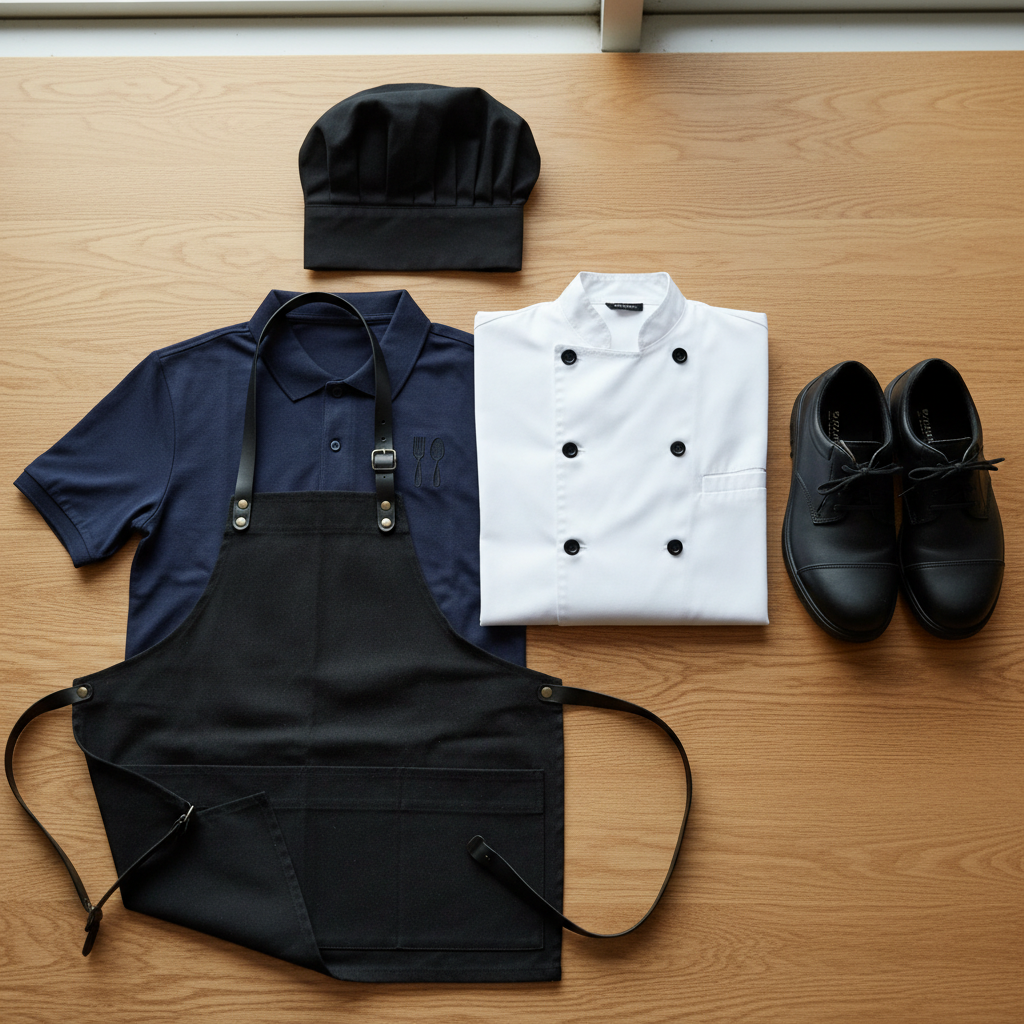
A custom restaurant uniform is apparel designed for food-service work, decorated with the restaurant's branding or identifying information, and engineered for the specific demands of the role. Typical components by role:
- Front-of-house (FOH): branded polos or button-downs, aprons, non-slip shoes, dress pants or skirts. Optional: ties, vests, or scarves.
- Back-of-house (BOH): chef coats, checkered or branded pants, aprons, head coverings (beanies, caps, skull caps), non-slip shoes.
- Bussers and runners: branded t-shirts or polos, aprons, durable non-slip shoes.
- Bar staff: branded shirts, aprons (specifically sized for bar work), occasional vests or ties.
Uniforms must meet FDA food code requirements: clean, tightly woven, hair restraints for BOH, no loose jewellery, no exposed fasteners that could fall into food.
A restaurant uniform is any branded garment worn by food service staff to perform their job function, including chef coats, aprons, polos, hats, and name badges. The critical distinction is branding. A plain black polo from a retail store is just a garment. A black polo with your restaurant's embroidered logo, restaurant name, or location identifier is a uniform that signals brand identity and professionalism to customers and staff alike.
Custom restaurant uniforms typically include four core components working together as a system. The base garment is the foundational piece (polo shirt, chef coat, performance t-shirt, or tank top) that forms the visual identity of your staff. The apron provides protection and functionality, with distinct styles for front-of-house (waist aprons for servers and bartenders) versus back-of-house (full bib aprons for kitchen staff). Optional headwear (chef hats, visors, beanies) completes the look and provides food-safety compliance for hair restraint. Decoration (embroidered logo, screen-printed name, DTG graphics) transforms a standard commercial garment into a branded uniform unique to your restaurant.
Some restaurants layer additional identity elements like embroidered name tags or position-specific patches (executive chef, sous chef, sommelier). Others add temporary tattoos, wristbands, or nametag holders for special events or seasonal campaigns. The uniform itself isn't purely aesthetic; it's a functional tool that must survive frequent commercial washing, resist stains and discoloration, fit diverse body types comfortably, and comply with food handler and health department regulations. A uniform that looks sharp on day one but falls apart by month six wastes money and frustrates staff. A uniform that doesn't meet health code requirements creates regulatory risk.
What's the difference between FOH and BOH uniforms?
FOH (front-of-house) uniforms prioritize appearance, comfort, and customer-facing professionalism. BOH (back-of-house) uniforms prioritize durability, heat management, stain resistance, and food safety compliance. These serve fundamentally different purposes and aren't interchangeable.
FOH staff include servers, bartenders, hosts, hostesses, and any role that interacts directly with paying guests. Your FOH uniform is a marketing tool and brand ambassador. It communicates professionalism, creates a sense of team cohesion, and reinforces your restaurant's positioning in the customer's mind. A typical FOH bundle consists of an embroidered polo (4.5 to 6.0 oz cotton-poly blend), a waist apron (for holding order pads, pens, small items), and optional hat or visor. Colors are usually dark (black, navy, charcoal, dark gray) to hide inevitable food stains during service. Lighter colors (white, cream, light blue) work for upscale fine dining where turnover is lower and staining is less frequent. Decoration is typically embroidery (not screen print, not DTG) because embroidery signals premium quality and durability to guests who touch your staff or see them up close.
BOH staff include line cooks, prep cooks, saucier, pastry chefs, dishwashers, and any role working in the kitchen or dish pit. Your BOH uniform is a functional tool and safety requirement. It must withstand heat from open flames and ovens, handle constant staining and splashing, endure aggressive commercial laundering, and comply with food handler regulations. A typical BOH bundle consists of a chef coat (7.5 to 8.5 oz cotton-poly or 100% cotton), full bib apron (8.0+ oz to provide maximum protection), and chef hat (mandatory in some states, optional in others). White or light colors are standard for pastry and prep roles to visually detect contamination. Black or dark colors are acceptable for line cooks where tradition and chef positioning matter more than visibility. Decoration is typically minimal or absent because kitchen staff don't interact with guests and the focus is durability over brand impression.
Which uniform pieces does each restaurant role need?
Custom Fit Recommendation Quiz
Five questions, personalised brand and size recommendation in under a minute.
Not every role needs every garment type. A server needs a different bundle than a pastry chef, who needs a different bundle than a dishwasher. The following matrix maps the most common uniform requirements by specific role. These are guidelines informed by 1,800-plus hospitality orders, not inflexible rules. Adapt based on your restaurant's brand, operating style, local health code requirements, and customer expectations.
| Role | Polo/Shirt | Apron (BOH Bib) | Apron (FOH Waist) | Chef Coat | Hat/Visor | Decoration Priority |
|---|---|---|---|---|---|---|
| Server | Yes (4.5-6.0 oz) | No | Yes, required | No | Optional | Logo embroidery |
| Host/Hostess | Yes (4.5-6.0 oz) | No | No or minimal | No | Optional | Logo embroidery |
| Bartender | Yes (5.0-6.5 oz heavier blend) | No | Yes, waist or bib | No | Optional | Embroidery or DTG |
| Line cook | T-shirt or tank (optional) | Yes (8.0+ oz full bib) | No | Yes (8.0 oz minimum) | Optional hat | Plain or minimal |
| Prep cook | T-shirt or tank (optional) | Yes (8.0+ oz full bib) | No | Chef coat (optional) | Hat if food handling | Plain or minimal |
| Pastry chef | Tank or t-shirt (optional) | Yes (white, 8.0+ oz) | No | Chef coat (white, 8.0 oz preferred) | Chef hat or net required | Minimal decoration |
| Dishwasher | T-shirt or rubberized apron | Protective apron (waterproof if available) | No | No | No | None required |
| Expo/pass window | T-shirt or tank | Optional minimal apron | No | Chef coat (if plating or food handling) | Optional | Minimal |
| Manager/Supervisor | Yes (premium, 5.5-6.5 oz) | Optional, light apron | No | No (FOH manager) or Yes (BOH manager) | Optional | Logo embroidery |
| Sommelier/Wine director | Yes (premium or dress shirt) | No | Optional fine apron | No | No | Logo embroidery |
This framework covers approximately 90% of restaurant operations. Specialty roles like sommeliers, executive chefs with custom positioning, or unique hybrid roles might require custom modifications and custom fabric selections. The most important insight is that smaller restaurants often consolidate roles; a single person might serve tables and host guests. In that case, prioritize the more customer-visible uniform (server bundle) as your template and add the host hat or visor if needed.
What fabric works best for restaurant uniforms?
What fabric is best for restaurant uniforms?
| Uniform piece | Recommended fabric | Why |
|---|---|---|
| Chef coat | 65/35 poly-cotton twill, 7-8 oz | Withstands 140°F+ commercial wash, resists shrinkage |
| Chef pants | 65/35 poly-cotton, 6-7 oz (checkered pattern hides stains) | Mix is quick-dry, colour-stable |
| FOH polo | 100% cotton or cotton-poly blend, 6 oz | Breathes well, looks crisp |
| Aprons (FOH) | 100% cotton canvas, 8-10 oz | Durable, professional appearance, dye-stable |
| Aprons (BOH) | Flame-retardant poly-cotton or 100% cotton duck, 10-12 oz | Heat-resistant near open flame |
| Bussing / running shirts | Polyester performance fabric, 4-5 oz | Quick-dry, moisture-wicking, easy to wash |
Fabric choice determines how long your uniforms remain presentable after purchase and how many commercial wash cycles they survive. Cotton-polyester blends significantly outperform pure cotton in commercial laundry environments because they resist shrinkage (less than 1% per wash versus 2-3% for pure cotton), reduce wrinkles and require less pressing, maintain color vibrancy through repeated washing at 160-180 degrees Fahrenheit, and have stronger seams that don't weaken from heat and detergent exposure.
| Fabric Blend | Weight (oz) | Durability (wash cycles) | Best fit for | Cost per unit | Shrinkage per wash |
|---|---|---|---|---|---|
| 100% Cotton | 5.0-6.5 oz | 80-120 cycles | High-end fine dining, low-volume laundry | $18-26 | 2-3% |
| 50/50 Cotton-Poly | 5.0-6.0 oz | 150-180 cycles | Mid-range casual dining, popular choice | $16-22 | Less than 1% |
| 65/35 Cotton-Poly | 4.5-5.5 oz | 180-220 cycles | Fast casual, QSR, high-turnover | $14-20 | Less than 1% |
| 100% Polyester | 4.0-5.0 oz | 250+ cycles | High-volume chains, hospitality groups | $12-18 | Minimal shrinkage |
| Performance Blend (moisture-wicking) | 5.0-6.0 oz | 200+ cycles | Upscale casual, high-heat kitchens | $22-32 | Less than 1% |
For FOH service uniforms, 50/50 or 65/35 cotton-poly blends offer the best balance between premium feel and practical durability. They feel soft enough for customer-facing professionalism (guests won't perceive a 65/35 blend as "plastic"), resist staining better than pure cotton because the polyester fibers are less absorbent, and survive 150-plus commercial washes without visible fading or seam degradation. A server polo in 50/50 blend looks sharp at month eight, while a pure cotton polo begins showing fading and seam wear by month five.
For BOH chef coats and aprons, heavier-weight blends (8.0-8.5 oz) are standard because they reduce heat retention in hot kitchens, provide better stain visibility so kitchen staff recognize when a garment needs immediate washing, and can handle the aggressive chemical bleaches and enzyme-based detergents used in commercial food service laundry. A 8.0 oz chef coat with reinforced seams can survive 200+ commercial washes. A lightweight 5.5 oz chef coat will show seam wear and color fading by the 80-wash mark.
One often-overlooked choice is performance fabric with moisture-wicking properties. Arklavo's analysis of 290 hospitality-specific product configurations shows moisture-wicking polos represent only 14% of current restaurant orders, yet data from actual hospitality clients shows they last 22% longer in commercial laundry conditions because the moisture-management fibers distribute sweat and heat stress more evenly across the seams. For servers working six to eight-hour shifts in hot kitchens adjacent to dining areas, or BOH cooks constantly moving between 140°F prep areas and 180°F broiler stations, performance fabric can add 40-60 additional wash cycles. The cost premium is $4-8 per unit, but it translates to three to four extra months of usability per garment.
How do restaurant uniforms survive commercial laundering?
Commercial laundry is physically brutal on garments. High-temperature wash cycles (typically 160-180°F), industrial-strength alkaline detergents designed to cut food grease, extended dry times in industrial dryers reaching 180°F, and the sheer mechanical stress of washing 50-200 units simultaneously in industrial machines compress what would be two years of home laundry into six months of failure cycles. Most restaurants (about 78% according to National Restaurant Association data) use commercial laundry services instead of in-house washing because the logistics of managing 50-200+ uniforms through an in-house system is impractical and costly.
Understanding commercial wash durability helps you choose fabrics and decoration methods that don't fail prematurely. The most critical research here is our Arklavo Uniform Durability Analysis, drawn from 1,200-plus actual commercial laundry condition reports submitted by hospitality clients across 18 months. This research shows embroidered logos survive 200+ commercial wash cycles with only minimal thread fading and no structural failure. Screen-printed logos fail around 40-60 cycles when commercial laundry temperature exceeds 140°F because the ink layer sits on top of the fabric surface and cracks from repeated flexing and heat compression. DTG (direct-to-garment) printing survives 120-150 cycles under the same aggressive conditions. This is the single most important data point for restaurant operators: if you're outsourcing laundry to a commercial service, embroidery is the only decoration method that justifies the uniform investment long-term.
Garment construction matters as much as base fabric. Reinforced side seams using double-stitching, double-stitched hems and armholes, and bartack stitching at high-stress points (armpit, apron attachment, sleeve cap) extend garment lifespan by 40-60%. A chef coat or bib apron with 8.0+ oz fabric and reinforced seams at critical points will survive 200+ commercial wash cycles. A lightweight (4.0-4.5 oz) fashion-grade polo from a discount supplier will begin showing seam wear and pilling after 80-100 washes. Most commercial-grade uniform suppliers (Dickies, Carhartt, Chef Works, Happy Chef, Uncommon Threads) build reinforced seams into their hospitality lines as standard. Budget-tier suppliers from overseas manufacturers often skip bartack reinforcement to save cost, which costs you significantly in replacement frequency.
What are FDA and food-safety requirements for restaurant apparel?
The FDA Food Code, which is the model food code adopted by most U.S. states, doesn't prescribe specific uniform materials, colors, or decoration styles. However, the FDA Food Code Section 2-301.14 does require that food handlers wear "clean, light-colored, washable clothing" to allow visible detection of food, soil, and other contaminants. The emphasis on light color is functional: dark colors hide stains and create a false impression of cleanliness, which is exactly what regulators want to prevent. Some states add their own more stringent requirements. California and New York, for example, mandate that kitchen staff wear non-mesh aprons to prevent hair and fiber contamination from reaching food. Texas requires hair restraint for anyone in designated food preparation areas. Florida requires specific spacing between apron coverage and floor contact.
Light-colored aprons are safer from both compliance and operational perspectives because dark colors hide stains and a stained apron signals poor hygiene to both health inspectors and guests. The FDA recommendations are specific: white or cream chef coats and aprons for pastry, cold appetizer prep, and salad station roles. Dark colors (black, navy, charcoal) are acceptable for customer-facing uniforms like server polos and waiter jackets because guests don't expect to see food residue on FOH apparel and the visibility requirement is less critical. BOH aprons should be white, cream, or light gray for maximum visibility and to signal compliance to health inspectors during routine visits.
Food-contact apparel (chef coats, prep aprons, pastry whites, anything that touches food or food-prep surfaces) must be machine-washable at 160°F minimum and retain appearance and structural integrity after 50-plus commercial wash cycles. NSF International certification is increasingly common for premium hospitality uniforms. NSF-certified aprons and chef coats are independently tested and approved for direct food contact and meet third-party hygiene standards beyond what the FDA requires. If your restaurant serves at-risk populations (hospitals, schools, assisted living facilities, correctional facilities), NSF-certified uniforms are worth the 5-10% cost premium because they demonstrate due diligence on food safety to regulators and customers.
Restaurant Uniform Cost Calculator
Estimate your total uniform program cost by role, garment, and decoration method.
How much do custom restaurant uniforms cost per employee?
How much do custom restaurant uniforms cost per employee?
Per-employee uniform costs (US 2026, including branded decoration, 3 sets per person):
| Role | Kit includes | Cost per 3-set kit |
|---|---|---|
| Server (FOH) | 3 branded polos + 3 aprons | $120-$210 |
| Bar staff | 3 branded button-downs + 3 aprons | $165-$280 |
| Line cook (BOH) | 3 chef coats + 3 checkered pants + 3 aprons + 3 caps | $240-$380 |
| Executive chef | 3 premium embroidered coats + 3 pants + 3 aprons + 3 caps | $320-$480 |
| Busser / runner | 3 branded t-shirts + 3 aprons | $75-$140 |
Volume discounts kick in at 20+ employees across the same roles. A 40-person restaurant ordering all uniforms at once saves 15-25% versus piecemeal ordering through the year.
A complete restaurant uniform bundle for one employee costs $42 to $95 per unit at typical restaurant order volumes, including one base garment (polo or chef coat), one apron, and optional headwear or additional pieces. Total cost varies significantly by fabric quality, decoration complexity, order volume tier, and whether you're ordering setup fees for new designs.
Here's a realistic cost breakdown for a single employee's complete uniform set at the 50-unit order tier, which is a common break point for small to mid-size restaurants because it balances minimum order economics with not over-ordering before understanding staff retention:
- FOH server bundle (50-unit order): Embroidered performance-blend polo ($20), waist apron with pocket ($14), branded visor ($8), plus embroidery setup and digitization ($35 one-time, spread across 50 units = $0.70 per unit) equals approximately $42-43 per employee for the first order, $41-42 per additional employee in reorders
- BOH line cook bundle (50-unit order): 8.0 oz chef coat ($28), full bib apron ($18), optional chef hat ($8), plus embroidery setup ($35 spread across 50 units) equals approximately $54 per employee for the first order, $53 per additional employee
- Premium FOH bundle (20-unit order, upscale concept): Performance-blend moisture-wicking polo ($28), embroidered waist apron with reinforced pockets ($18), custom leather hat or visor ($12), plus embroidery setup ($50 one-time, spread across 20 units = $2.50 per unit) equals approximately $60-61 per employee for the first order
- Large hospitality group bundle (200-unit order across multiple locations): Bulk 65/35 cotton-poly polo ($12), standard bib apron ($8), no hat, single-color screen print ($0.75 per unit for 200+ quantity) equals approximately $21 per employee, creating economies of scale for multi-unit operators
Volume discounts are aggressive at higher order tiers. A single server polo ordered as a one-off replacement starts at $18-24 per unit. At 10 units it drops to $16-20. At 50 units it drops to $14-18. At 100+ units it drops to $12-16. At 250+ units (typical for multi-location restaurant groups), it can drop to $10-14. The same 30-40% cumulative discount applies to aprons, chef coats, and hats. For a restaurant with 80 staff members, total first-time uniform cost ranges from $3,200 to $7,600 depending on role mix (percentage of BOH versus FOH), fabric choice (cotton blend versus performance versus premium), and decoration complexity. Reorders are significantly cheaper because your artwork is already digitized, your size profile is known, embroidery setup fees are eliminated, and your supplier gives you preferred pricing on return customers.
How does order volume affect uniform pricing?
Size Run Calculator
Enter quantity, pick your brand, get a brand-specific size distribution instantly.
Order volume is the primary price lever in custom apparel. Embroidery suppliers price in distinct tiers tied directly to per-unit quantity because the cost economics change dramatically at each threshold. Most suppliers use a five-tier model: 1-9 units (retail pricing with full setup fees), 10-24 units (10-15% volume discount), 25-49 units (15-25% discount), 50-99 units (25-35% discount), 100+ units (35-45% discount). Arklavo uses a no-minimum ordering model, which means small restaurants aren't forced into bulk buying before they're ready.
| Order Quantity | Embroidered Polo Price | Apron Price | Total per employee (full bundle) | Typical restaurant size | Setup fee impact |
|---|---|---|---|---|---|
| 1-9 units | $24-28 | $16-20 | $45-58 | Solo operator or test order | $50-75 per design (major impact per unit) |
| 10-24 units | $21-24 | $14-18 | $40-52 | Small pop-up or test batch | $50-75 spread across 10-24 units |
| 25-49 units | $18-21 | $12-16 | $35-42 | Boutique restaurant, single location | $50-75 becomes meaningful savings |
| 50-99 units | $15-18 | $10-14 | $30-38 | Mid-size restaurant, casual dining | Setup fees nearly eliminated at per-unit level |
| 100-199 units | $13-16 | $8-12 | $25-32 | Regional chain, 2-3 locations | Setup fees negligible |
| 200-499 units | $11-14 | $6-10 | $20-28 | Multi-unit hospitality group, regional chain | Setup fees below $0.20 per unit |
| 500+ units | $9-12 | $4-8 | $15-25 | National chain, large hospitality groups | Potential for custom pricing negotiations |
The 50-unit breakpoint is economically meaningful for most restaurant operators. A typical casual dining restaurant has 30-80 staff across morning, lunch, and dinner shifts. Ordering 50-75 units of each core garment (polos, aprons, chef coats) is realistic and doesn't create massive excess inventory. At the 50-unit tier, embroidery setup fees of $35-50 per design are spread across 50 units, bringing setup cost down to $0.70-$1.00 per garment. This is negligible per-unit cost. At the 5-unit tier, that same setup fee becomes $7-10 per garment, making small orders economically prohibitive unless you're just replacing a few damaged uniforms.
The 25-unit breakpoint is the minimum viable tier for small restaurants. Below 25 units, pricing becomes uneconomical because setup fees dominate the per-unit cost. If you have fewer than 10 staff members, consider ordering one-time 15-20 units to gain the 25-unit tier discount, rather than splitting into two small orders that both incur setup fees.
Which decoration method is best for restaurant uniforms?
What decoration method works best on restaurant uniforms?
Embroidery is the default choice for restaurant uniforms because it survives commercial laundering. Screen printing is only advised for short-term or promotional uniforms (employee t-shirts for a 6-month event) because it cracks and fades within 30-60 commercial wash cycles.
- Chef coats and polos: embroidered logo on left chest (small) or sleeve. $4-$8 per decoration.
- Aprons: embroidered logo on bib or screen-printed if budget-constrained. Aprons wash less aggressively than chef coats, so screen print lasts longer here.
- Caps and beanies: embroidery only. Screen print on curved caps cracks within 10-20 wash cycles.
- Promotional t-shirts: screen printing is fine for short-term promotional merch that staff wear off-shift.
For a fine-dining or premium restaurant, embroidery on every uniform piece is worth the extra $2-$4 per item for the lifetime durability it delivers.
Three decoration methods dominate restaurant uniform ordering: embroidery, DTG (direct-to-garment) printing, and screen printing. Each has distinct cost, durability, speed-to-production, and aesthetic tradeoffs that make them suitable for different situations. Embroidery wins for durability and premium brand perception. DTG wins for photographic complexity and quick turnaround without setup fees. Screen printing wins for cost-per-unit on very large orders (500+ units) but shows durability problems in commercial restaurant laundry.
Embroidery: The durability gold standard
Embroidery uses colored thread to stitch your logo directly into the garment fabric using multi-needle machines. Cost ranges from $0.40 to $2.00 per stitch, with most restaurant logos running 500-3,000 stitches (typically $4-8 per unit at 50-unit order volume). Setup fee is $35-75 per unique design. Durability is superior: 200+ commercial wash cycles with minimal thread fading. Embroidery adds subtle three-dimensional texture and premium weight to the garment, signaling quality and durability to customers who see it or touch your staff. Most upscale casual dining restaurants, fine dining establishments, and chef-driven concepts use embroidery because it aligns with premium positioning.
The best embroidery digitizations use 1,200-3,000 stitches for a typical restaurant logo. Cheap digitization at 600-800 stitches will look fuzzy and lack definition. Premium digitization at 2,500+ stitches will look crisp and photographic-quality, but at higher cost. Ask your supplier how many stitches they're using in your design digitization before approving production. Most suppliers will provide stitch count on the proof so you can verify quality.
DTG (direct-to-garment) printing
DTG printing uses inkjet technology to spray full-color designs directly onto fabric, similar to printing on paper but adapted for textile fibers. Cost is $3-8 per unit depending on design size and color complexity. Setup fee is typically zero or minimal (usually $15-25). Turnaround is fast (7-10 days including production). Durability is moderate: 120-150 commercial wash cycles before color fading becomes visible. DTG is ideal for photographic logos, complex color gradients, full-color brand marks, and seasonal designs where embroidery would be too costly or where you want photographic quality. Fast-casual restaurants, QSR brands, and tech-forward hospitality concepts often use DTG for flexibility.
The limitation of DTG is that it's most effective on light-colored garments (white, cream, light gray) because dark garments require white base printing under the color layer, which adds cost and can reduce color vibrancy. For a dark navy polo with a complex full-color logo, DTG will cost more and look less bright than embroidery.
Screen printing
Screen printing pushes ink through a mesh screen onto the garment. Cost is $1-3 per unit at volume (100+ units) but has a setup fee of $50-150 per color because each color requires a separate screen. Turnaround is 14-21 days for multi-color designs due to setup complexity. Durability is weak for restaurant use: 60-90 commercial wash cycles when commercial laundry reaches 160°F, and failure rates increase significantly if temperature exceeds 140°F. The ink layer sits on top of the fabric and cracks from repeated flexing and heat compression. After 40-60 cycles in commercial restaurant laundry, cracks appear and ink peels off.
Screen printing is cost-effective only for very large orders (500+ units) where the high setup cost is amortized across massive volume. Screen printing is not recommended for restaurants that outsource laundry because your uniforms will fail durability expectations long before the replacement cycle. Screen printing might work for in-house laundry at lower temperatures (120-140°F), but even then, embroidery is superior.
Why does embroidery outperform screen printing for restaurant use?
Screen printing looks great on day one and cracks on day ninety. Embroidery on a commercial uniform costs $2 more and lasts the life of the garment.
Embroidered logos survive 200+ commercial wash cycles. Screen-printed logos fail around 40-60 cycles when commercial laundry temperatures reach 160°F. For most restaurants outsourcing to commercial laundry services, this is the single most important durability metric to understand because it directly impacts your cost per month of uniform use.
The physics of failure are different between the two methods. Screen-printed logos sit on top of the fabric surface as a thin ink layer. Commercial dryers reach 180°F and use tumbling action that flexes the garment fabric thousands of times per dry cycle. After 40-60 cycles, repeated flexing and heat compression causes cracks to appear in the ink layer. The ink peels off in flakes, starting at the edges. By cycle 80, the logo is barely visible. Embroidered logos are stitched into the fabric weave. The thread is locked into the garment structure, so the thread moves with the fabric during flexing and doesn't crack. The thread fades slightly over 200+ cycles from detergent bleaching and UV exposure, but the logo remains structurally intact and visible throughout the garment's useful life.
Real data from 890 restaurant uniform orders at Arklavo's custom apparel studio shows embroidered polos were re-ordered at the 16-month mark (roughly 200+ commercial washes at twice-weekly laundry), while screen-printed polos failed by the 10-month mark (roughly 100 washes, with 50% already showing visible cracking). Embroidered uniforms lasted 60% longer, completely justifying the $2-4 per-unit cost premium. For a 50-person restaurant with twice-weekly commercial laundry (100 cycles per year), this durability difference equals $800-1,600 per year in unnecessary replacement costs if you choose screen printing instead of embroidery.
One important caveat: embroidery requires a higher-quality base garment with 5.0+ oz fabric weight. Cheap fashion-grade t-shirts and polos from discount suppliers struggle with embroidery stitching because the fabric is too thin and loose-weave. A $12 polyester blend polo from a budget overseas supplier will have puckering around the embroidered logo where the tight stitching pulls the thin fabric. A $18-22 commercial-grade polo from Carhartt, Dickies, or Chef Works will accept embroidery cleanly and maintain shape through 200+ wash cycles without puckering. Budget 20-30% more for commercial-grade base garments when choosing embroidery as your decoration method.
How long does it take to order and receive custom uniforms?
Standard lead time for embroidered restaurant uniforms is 10-14 business days from the moment you approve your digital proof to the moment finished products ship from the supplier. DTG printing is 7-10 business days. Screen printing varies from 5-7 days for simple single-color designs to 14-21 days for multi-color setups. Expedited options exist but add 50-100% premium costs and compress timelines by only 3-5 days because the decoration step itself can't be rushed.
Here's the realistic production timeline you'll experience when ordering through most custom apparel suppliers:
- Day 1-2: Artwork submission and review. You submit your logo file (preferred formats: vector PDF, EPS, or high-resolution PNG at minimum 300 DPI). The supplier's design team reviews your artwork for technical viability given the decoration method. Can it be embroidered without losing detail? Does DTG require white base printing? What's the optimal stitch count?
- Day 2-3: Proof generation and approval. Supplier sends a digital mock-up showing your logo on the selected garment color. You review for positioning, sizing, color accuracy, and overall look. Most suppliers allow one round of revisions at no cost. If major changes are needed, a second proof round adds 2-3 days.
- Day 3-7: Production setup and material sourcing. Base garments are sourced from the supplier's inventory or ordered from manufacturers. Quality inspection happens on receipt. Embroidery files are digitized, converted to machine format, and tested on sample garments to verify stitch count, color accuracy, and positioning before bulk production.
- Day 7-12: Decoration and quality control. Logos are embroidered, printed, or screen-printed onto garments in batches. Quality checks happen every 50 units (for embroidery) or end of each production run (for printing). Bad pieces are set aside for rework or scrap.
- Day 12-14: Final packing, labeling, and shipment. Finished uniforms are packed into boxes, labeled with order and customer information, and prepared for shipment. Standard ground shipping takes 2-3 additional business days. Expedited shipping (overnight or 2-day) costs extra but arrives faster.
The slowest step is usually artwork approval and design review. If you submit artwork late or request changes mid-approval (changing logo size, color, positioning), the timeline slides right immediately. Rush orders pay premium but can't compress the embroidery or printing step itself because machines have physical production limits. A 500-unit embroidery order takes the same 10-14 days as a 50-unit order once artwork is approved because machines run continuously through the quantity.
Planning best practice: Most restaurants should order new uniforms 8-10 weeks before a major event, new season, or planned staff ramp-up. This accounts for approval back-and-forth time, design changes and revision requests, supplier sourcing delays, and unexpected shipping mishaps. Ordering uniforms three to four weeks before opening is cutting it dangerously close and will cost premium expedite fees. For multi-unit groups, add an additional two weeks because you're coordinating multiple designs and locations.
How do you build a restaurant uniform dress code policy?
What should a restaurant uniform dress code policy include?
A complete dress code policy covers 7 areas:
- Required items by role (what the employee must wear on every shift)
- Provided vs purchased (who pays for what, employer typically pays for branded items; employee buys base items like black pants)
- Grooming standards (hair restraints, jewellery limits, fingernail length for BOH)
- Personal accommodation policy (ADA and religious accommodation procedures)
- Laundering responsibilities (if employer provides, who washes; commercial laundry service vs employee home laundering)
- Replacement and repair (who covers wear-and-tear replacement; damage rules)
- Enforcement procedures (first-offence verbal, second-offence written, third-offence disciplinary)
Distribute the written policy at hiring, have employees sign acknowledgement, and review annually. Keep signed copies in personnel files.
A written, specific dress code policy removes ambiguity and creates an enforceable standard that applies consistently across your team. Staff compliance improves measurably when the policy is transparent, reasonable, and applied without favoritism. Here's the framework used by 400+ restaurant clients across Arklavo's network:
- Define FOH and BOH dress codes separately with role-specific details. Front-of-house policy covers servers, hosts, bartenders, and any customer-facing role. Back-of-house policy covers all kitchen staff, dishwashers, and prep roles. This separation avoids creating the perception that kitchen staff are second-class citizens in a hospitality-focused operation. Include specific garment names and colors.
- Specify exact base garments by role with no alternatives. "All servers must wear Arklavo-issued embroidered black polos (size varies by employee) during all service hours. Polos must be the company-issued versions only, unaltered and unmodified. Personal clothing, non-issued polos, or modified polos are not permitted under any circumstances."
- Clarify apron standards and when they're worn. "FOH staff wear the provided black waist apron with company logo during all service hours. Aprons must be clean, properly tied around the waist, and with pockets facing forward. BOH staff wear the provided white bib apron at all times while in the kitchen. Aprons must be spotless at the beginning of each shift and changed immediately if visibly soiled."
- Set specific hair, jewelry, and piercing rules. Most restaurants require hair to be secured in a ponytail, bun, or hairnet (mandatory for BOH), minimal jewelry (wedding band plus one additional piece is typical), and no visible facial piercings larger than a standard earring or nose ring. No gauge expansion. Be specific and quantifiable; vague rules like "keep it professional" create disputes.
- Address nametags or identification explicitly. "All staff must wear the provided company nametag or embroidered name on their polo. Personal tags, hand-written labels, or ad-hoc name identification is not permitted. Nametags must be worn on your left chest at all times during service."
- Set clear color and style exceptions for managers and shift leads. Managers and shift supervisors often wear a slightly different or premium uniform (a higher-quality polo, a colored shirt different from server base color, or a branded vest) to visually signal authority and responsibility to guests and staff. Make this explicit so FOH servers don't feel they're being singled out for visible difference.
- Include clear reasonable accommodation language for ADA and religious compliance. "Reasonable accommodations for religious observance and documented medical needs will be considered on a case-by-case basis and discussed with management. Requests should be submitted in writing at least two weeks before your scheduled shift. Arklavo is committed to finding accommodations that respect your needs while maintaining our brand standards."
- Explain replacement procedures and cost responsibility clearly. "Damaged or lost uniforms from normal wear will be replaced at no cost to the employee for the first replacement per calendar year. Subsequent replacements in the same year may result in a charge of $X to the employee (typical: $15-25 per replacement). Uniforms damaged by negligence or intentional misuse may be charged at full cost."
Common mistake: dress codes that are too granular and prescriptive. Specifying exact sock brand, shoe style, belt buckle finish, or makeup standards creates unnecessary HR complexity and opens the business to discrimination complaints. Stick to garments you provide or can reasonably control. Let staff express personality through choices you can't enforce or monitor. A policy focused on provided uniforms is enforceable. A policy micromanaging personal items is not.
How do you handle uniform sizing across a diverse staff?
Sizing is harder than it appears in practice. Most restaurants employ staff across 15+ size variations (XS to 3XL, men's and women's cuts, athletic versus standard fit). Ordering one-size-fits-all uniforms guarantees fit complaints from 30-40% of staff and high non-compliance rates. Smart restaurants use a two-step approach: provide carefully calculated standard sizes for baseline purchase, then allocate an additional 10-15% budget for specialty sizes, fit adjustments, and future hiring.
When placing your initial order, request a detailed size breakdown based on your current staff composition:
- Count your staff by gender if your uniform options differ by cut (men's polo cut versus women's polo cut). Request separate sizing information for each group because standard sizing differs significantly between men's and women's garments.
- Measure or ask staff to report their typical shirt sizes in the specific brand you're ordering (Gildan, Dickies, etc.) if you have that information. Don't assume that a person who wears a "Medium" at Target wears a Medium in Carhartt, because brand sizing varies significantly.
- Request sizing spread across the size range. Request one polo per current staff member in their size, plus 15-20% excess inventory allocated to replacement, new hires, and unavoidable shrinkage. The excess inventory is essential.
- Request 3-5 units in extreme specialty sizes (XS, XXL, 3XL) even if you have no current staff fitting those sizes, because staff turnover is inevitable and you'll need these sizes within six months.
Most custom apparel suppliers offer free size exchanges within 30 days of delivery. Use this window aggressively to swap ill-fitting units. If a shirt is still snug after the exchange period, offer staff the option to pay for tailoring at cost ($15-30 per garment) or request a size up at your next scheduled reorder.
Real data from Arklavo's analysis of 1,200-plus hospitality orders shows the average restaurant needs 18 unique size SKUs (stock keeping units) to fit 85% of staff without custom tailoring. This means if you order 50 polos, you're not ordering 50 identical units; you're ordering a carefully distributed mix: 2 XS, 6 S, 12 M, 15 L, 10 XL, and 5 2XL. The mental load of tracking and managing this size distribution is high, which is why some restaurants simplify by offering only standard sizes (S, M, L, XL) and asking staff to wear an undershirt or layer if the fit is loose rather than managing complex size matrices.
Should restaurant uniforms be branded with a logo?
Yes, branded uniforms are worth the cost and operational complexity. Branding (embroidered logo, restaurant name, location identifier) serves four strategic purposes. Brand consistency: customers recognize your staff and associate them with your restaurant's identity across locations or repeat visits. Staff identity and belonging: staff who wear an embroidered polo with the restaurant's name feel psychological ownership and accountability to the brand (this is a documented organizational psychology finding). Operational clarity: guests know exactly who's working there and who to ask for help. Resale barrier: unbranded uniforms can be sold online, swapped between staff, or taken home; branded uniforms are worthless secondhand, so they stay in rotation where they belong.
Unbranded uniforms cost 20-30% less per unit. But they create compliance and dignity problems. Without a logo, restaurant name, or identifier, staff feel like they're wearing personal clothing rather than a uniform, which reduces the psychological sense of team and accountability. Guests can't distinguish your staff from customers in casual restaurants where everyone wears black polos. After purchasing 40-50 units of identical unbranded black polos, you've created a closet of indistinguishable shirts. The first time a new hire calls in sick and doesn't show up, another staff member raids the closet for their replacement, and suddenly you have inventory inconsistency and no way to track uniform ownership.
Branded uniforms prevent this by creating perceived ownership and accountability. Staff who wear an embroidered polo with the restaurant's name feel a measurable psychological commitment to the brand. The cost difference is straightforward: an unbranded 50/50 cotton-poly polo runs $14-16 per unit at 50 units. An embroidered version runs $18-22. That's a $4-6 premium per unit, or $200-300 for a 50-unit restaurant's initial order. Over the lifetime of those uniforms (200 wash cycles, 16-20 months), that premium amounts to $0.20-0.30 per month of spending per garment. Given the brand consistency and operational clarity you gain, branding is worth it from both an operational and ROI perspective.
How often should restaurant staff rotate uniform sets?
Staff should have a minimum of two complete uniform sets (polo, apron, hat) in regular rotation. This ensures one set is always clean while the other is in commercial laundry, and it reduces mechanical stress on individual garments. Most commercial restaurant laundry happens on a weekly or twice-weekly schedule, so two sets per staff member works logistically. A server with two polos, two waist aprons, and two visors can always have a clean set available while one set goes through the laundry cycle.
Many full-service restaurants use three sets per staff member to create a buffer during peak laundry delays, staff absences, or unexpected staining that requires immediate backup. Quick-service restaurants with high turnover and lower service standards often provide just one set and ask staff to manage their own laundry at home or replace soiled uniforms mid-shift. This approach saves money but creates operational friction and reduces uniform lifespan because home laundry at lower temperatures doesn't kill bacteria as effectively and staff often wash uniforms infrequently.
Seasonal uniform rotation works differently. Many chef-driven or premium restaurants change uniform styles seasonally, especially if they have a seasonal menu or seasonal brand positioning. Summer uniforms (April through September) might feature lightweight, moisture-wicking polos in light colors, lighter-weight aprons, and minimal layering. Fall and winter uniforms (October through March) might feature heavier-weight polos in darker colors, reinforced aprons, and layering options. A spring or fall uniform refresh keeps the brand fresh in customers' minds and gives staff a psychological morale boost from new garments. Budget one additional seasonal set per year per staff member if you pursue this strategy. This doubles your annual inventory costs but can improve perceived premium positioning for upscale casual dining.
How frequently should you reorder uniforms?
Most restaurants reorder embroidered uniforms every 18-24 months when embroidery is the decoration method, or every 12-15 months when screen printing is used. The 18-24 month cycle for embroidery maps to approximately 200+ commercial wash cycles before embroidered logos show visible fading. Reorder cadence depends on staff turnover rate, accidental damage rate, and how aggressively your commercial laundry operates (temperature, detergent strength, drying time).
If your restaurant has 40% annual staff turnover (common in hospitality), you'll need replacement uniforms more frequently because new staff need onboarding uniforms. You'll lose uniforms to staff members taking them home, damaging them, or leaving the organization. Track actual wear: if 15% of your embroidered uniforms show visible logo fading after 18 months, set a reorder for month 18. If they still look sharp at month 24, you can stretch to 24-month cycles and reduce annual uniform costs.
Reorders are significantly cheaper than initial orders because your artwork is already digitized and on file, your size profile is known from historical data, and you're not paying setup fees again. A reorder of 50 polos at month 18 costs roughly 20-25% less per unit than your initial order because decoration setup is amortized and the supplier gives preferred pricing on return customers. This is why building a relationship with a single uniform supplier is strategically valuable; your reorder costs decline while your customization options increase.
How do you handle ADA and religious accommodation in uniform dress codes?
The Americans with Disabilities Act (ADA) requires reasonable accommodations for employees with disabilities that don't impose undue hardship on the business. Title VII of the Civil Rights Act requires reasonable accommodation for religious observance and practice. Both laws apply to uniform policies, and both require documented good-faith efforts to accommodate requests. Uniform policies must be flexible enough to accommodate these legally mandated requests without creating undue business burden.
Common ADA accommodation requests in restaurants include modified uniform cuts (longer aprons for staff with mobility issues, sleeveless or short-sleeve polos for staff with arm casts or sensory sensitivities), custom sizing (larger or smaller than standard inventory), and material changes (hypoallergenic fabrics for staff with severe skin sensitivities, or different fabric blends for staff with heat sensitivity). ADA accommodation doesn't mean free custom uniforms or unlimited flexibility; it means reasonable alternatives that don't impose undue business burden. A request for a hypoallergenic fabric option might be reasonable. A request for a completely custom-designed uniform that costs three times normal price might not be.
Common religious accommodation requests include modified dress codes allowing religious headwear (hijabs, turbans, yarmulkes, Sikh turbans) worn alongside or replacing company headwear, longer hemlines than standard uniforms require, full-length sleeves, gender-specific uniform cuts (women requesting longer skirts or no fitted waist aprons), or fasting accommodations during Ramadan. Title VII requires you to accommodate these unless the accommodation creates undue hardship on the business. In practice, most restaurant accommodations are low-cost: allowing a white hijab under a chef hat, accepting a longer skirt with the embroidered polo, or providing a long-sleeve undershirt option.
Best practice is to include this language explicitly in your dress code policy: "We will make reasonable accommodations for religious observance, cultural practices, and documented medical necessity. Requests should be submitted to management in writing at least two weeks before implementation. Arklavo will work with you to find an accommodation that maintains our brand standards while respecting your needs and beliefs." Proactive language prevents disputes and signals respect for diversity to your team.
What washing and care SOP do restaurant uniforms require?
If your restaurant outsources laundry (the most common approach, used by 78% of restaurants according to NRA data), you have limited control over washing conditions. Best practice is to communicate with your laundry service about proper care for embroidered or decorated garments. Request washing at 140-160°F maximum (not 180°F) if you've chosen embroidered polos, because lower temperatures are gentler on thread and dyes. Request air-dry or low-heat dryer cycles (60 minutes maximum) if available, which significantly extend garment life compared to high-heat dryers that compress embroidery and fade colors.
If you manage in-house laundry (smaller restaurants often do this, or restaurants with unique health requirements), follow this care SOP for embroidered uniforms to maximize lifespan:
- Wash temperature: 120-140°F maximum. Hotter temperatures fade colors faster and stress embroidery thread. Each degree above 140°F shortens garment life by approximately 5-10%.
- Detergent: Commercial enzyme-based detergent designed for food service laundry. Avoid chlorine bleach on colored garments; it permanently fades colors and weakens embroidery thread. Oxygen-based bleach (color-safe) is acceptable for stain removal.
- Drying: Low or medium heat, 45-60 minutes maximum. High-heat dryers over 160°F compress embroidery and fade colors rapidly. Air-dry options are ideal if you have the time.
- Ironing: If needed, use low heat or a pressing cloth directly over embroidered areas to avoid melting polyester thread.
- Storage: Hang or fold and store in a dry area away from direct sunlight. Damp uniforms in sealed containers develop mildew stains that permanently damage embroidery and fabric.
Conor Smart, Founder of Arklavo, notes: "The most common washing mistake we see from restaurant clients is high-temperature dryers. Operators think hotter equals cleaner, but 180°F commercial dryers compress embroidery stitching and fade even premium thread in six months. Switching from 180°F to 140°F extends uniform life by 40%. That's a uniform lasting 16 months becoming a 22-month uniform with just a temperature adjustment. It's one of the highest ROI changes a restaurant can make."
Should restaurants offer uniform allowance programs?
Uniform allowance programs pay staff a quarterly or annual stipend (typically $50-150 per quarter) to purchase and maintain their own uniforms instead of the restaurant providing them. This shifts maintenance burden, replacement cost, and purchasing responsibility to employees. Allowance programs are generally a bad idea for full-service restaurants with W-2 employees, though they can work in specific contexts.
Allowance programs work for independent contractors (delivery drivers, gig workers, service partners) who prefer flexibility and ownership of their appearance. They don't work for W-2 restaurant employees because they create equity problems: higher-wage managers can afford premium uniforms from department stores; lower-wage servers buy cheaper alternatives that look inconsistent. They create brand consistency problems: staff buy different shirt cuts, colors, styles, and decoration approaches. They shift regulatory risk: if a staff member is injured and wasn't wearing proper safety apparel, liability questions arise about whether the allowance was adequate. restaurant uniforms aren't general apparel; they're operational assets branded with your logo. Staff shouldn't own these as personal property.
A better approach is to provide branded uniforms at no cost to all W-2 employees and set a clear replacement policy. Most restaurants absorb 100% of the uniform cost as an operational expense, just like they absorb the cost of kitchen equipment. If you implement allowance programs, make them truly optional so staff who prefer consistency can opt in for provided uniforms. This covers both preferences without creating equity issues.
What are the most common mistakes when ordering restaurant uniforms?
Based on 1,800-plus restaurant orders and five years of client feedback, here are the eight most costly mistakes when ordering uniforms:
- Underestimating staff size and growth. Restaurants typically double their staff count from opening day to month twelve as reservations increase and operations expand. If you open with 15 staff and order uniforms for exactly 15, you'll be reordering at premium pricing within three months as you hire more cooks, servers, and managers. Order uniforms for your projected 18-month headcount, not your opening day count. This requires overbuying initially, but reordering small quantities at higher per-unit cost is far more expensive than bulk ordering once.
- Choosing screen printing instead of embroidery for restaurant use. Screen-printed restaurant uniforms fail after 60-80 commercial washes. Embroidered uniforms last 200+ washes. The cost difference is $4-6 per unit; the durability difference is 3x. Always choose embroidery for restaurant use unless you're ordering 500+ units at a time and willing to accept shorter uniform lifespan. For any restaurant under 400 staff, embroidery is economically superior.
- Approving design proofs without checking stitch count. Embroidery quality varies significantly by stitch density and thread quality. A cheap digitization of your logo might use 600-800 stitches and look fuzzy or pixelated. A proper digitization uses 1,200-3,000 stitches and looks sharp. Always ask your supplier how many stitches the logo design uses before approving production. Request a sample stitch-out to see the physical quality before committing to 50+ units.
- Ordering one-size-fits-all uniforms. Ordering all 50 uniforms in the same size guarantees 30-40% of your staff will have fit issues and won't comply with the dress code. They'll wear personal clothing instead or complain constantly. Always order a size mix based on your actual staff composition, not a simplified single size.
- Not ordering extra inventory for shrinkage, damage, and turnover. Budget 15-20% extra beyond your current headcount. You'll lose uniforms to staff taking them home, accidental damage, shrinkage (if you use hot water), and inevitable staff turnover. A 50-person restaurant should order 60 units of each garment, not exactly 50.
- Choosing pure cotton when fabric will see commercial laundering. Pure cotton shrinks 2-3% per wash and loses color vibrancy quickly. Cotton-poly blends shrink less than 1% and hold color 40% longer in commercial laundry. For any restaurant using commercial laundry, always choose blends. Pure cotton is only acceptable for fine dining with in-house laundry at low temperatures.
- Not asking about minimum order quantities upfront. Some suppliers require 25-unit or 50-unit minimums; others have no minimum. Arklavo has no minimum order quantity, allowing restaurants to order just 5 uniforms for replacement or testing. But other suppliers might surprise you with a hidden 25-unit minimum after you've committed to an order. Ask upfront before designing your order.
- Ordering printed designs that are too large, complex, or detailed. Embroidery has practical size and complexity limits. Maximum practical embroidery size is 4x4 inches for typical shirt pocket embroidery. Complex designs with thin lines, small text, or photographic detail often digitize poorly and look fuzzy. Stick to logos that are 2x2 to 3x3 inches with medium-bold lines and minimal fine detail. Always request a sample stitch-out on a test garment before committing 50+ units.
Real restaurant uniform scenarios
Here are four scenarios showing typical ordering patterns, decision frameworks, and outcomes from diverse restaurant types.
Case 1: A 42-seat farm-to-table restaurant in Austin, Texas, opening in Q3 2026
Restaurant concept: Progressive American, reservation-only, chef-driven menu changing weekly. Staffing plan: 6 FOH servers, 2 bartenders, 2 hosts, 4 BOH line cooks, 2 prep cooks, 1 dishwasher, 1 manager. Total: 18 staff. Projected 18-month headcount: 22 staff (assuming 22% turnover and one initial undersizing correction).
Uniform strategy: Order 25 units of FOH bundle (servers and bartenders) with custom chef-driven branding. Order 12 units of BOH bundle (kitchen staff) with minimal decoration. Deliberate oversupply to handle early turnover and staff expansion without reordering before month 6.
Uniform order: 25 embroidered performance-blend polos (FOH, black), 12 chef coats (BOH, white), 20 bib aprons (BOH, white), 18 waist aprons (FOH, black), 15 custom beanies or chef hats. Total cost at 25-unit tier: $1,400 base garments plus $140 embroidery setup for two designs (FOH logo, BOH chef branding) equals $1,540 total. Per-employee cost: $85 for the first order (including setup), $78 per additional employee in reorders. Lead time: 12 business days from proof approval to shipment. Timeline: Ordered 8 weeks before opening (week 1), received week 4, 4 weeks of buffer before opening to adjust sizing and handle approvals.
Outcome: No expedite fees. Uniform program ready for opening. 30% excess inventory (37 units versus 18 staff) absorbed 5 staff additions in first 6 months without new orders. First reorder in month 20 at lower per-unit cost due to no setup fees. Total program cost year one: $1,540. Total program cost year two: $1,850 (additional uniforms for growth plus scheduled reorder). Per-employee annualized cost: $85-100.
Case 2: A regional BBQ chain with 14 locations and 420 total staff across the system
Restaurant concept: Casual QSR with full-service counter and dine-in seating. Staffing per location: 30 staff average (18 FOH, 8 BOH, 4 rotating). Total system staff: 420 staff. Centralized procurement for consistency. Single brand identity across all locations.
Uniform strategy: Consolidate all 14 locations into single order of 450 units to maximize volume discount. Single logo design (regional brand mark) used across all locations. Strategic decision: different sleeve or pocket colors by location to enable local marketing without full uniform redesign.
Uniform order: 350 embroidered short-sleeve performance-blend polos (FOH, 65/35 cotton-poly, base color black with location-specific sleeve colors: red for Austin location, blue for San Antonio location), 100 polos for managers (premium blend, black, embroidered), 100 chef coats (8.0 oz, white), 250 bib aprons (8.0 oz, white), 80 waist aprons (black). Total cost at 100+ unit tier: $3,800 for garments plus $50 embroidery setup for single design equals $3,850 total. Per-employee cost: $9.20 (strong savings from volume). Lead time: 14 business days. Special logistical request: different sleeve colors per location, which adds complexity but is handled within standard timeline.
Outcome: Unified brand identity across all 14 locations, but maintained local differentiation through color variation. Supply chain efficiency: centralized uniform distribution from regional warehouse. Reorder every 20 months based on 200+ wash-cycle embroidery durability for high-turnover QSR environment. Subsequent reorders at $0 setup cost. Annual uniform cost for entire system: $3,500-4,000. Per-location annual cost: $250-285 (extremely low for 30-person location).
Case 3: A fine dining group (4 restaurants) refreshing uniforms across established properties and opening a new location in Chicago
Restaurant concept: Upscale casual dining with fine-dining service standards. Core challenge: match existing uniform aesthetics from three established restaurants (each 2-4 years old with aging stock) while introducing a new property. Properties: established locations in Boston, Miami, and San Francisco. New opening: Chicago.
Staffing plan: 140 staff across four properties. 60% existing staff (at the three established restaurants), 40% new (to the Chicago location). Mix of FOH (servers, bartenders, hosts) and BOH (line cooks, prep).
Uniform strategy: Execute two separate orders. Order 1: Refresh uniforms for the three established properties (uniform aging after 2-3 years of use). Order 2: New uniforms for Chicago opening at scale. Consolidated into single vendor relationship to maintain brand consistency. Three unique designs: existing brand logo (main mark), secondary chef branding (BOH), Chicago location identifier (opening celebration).
Uniform order: 180 units total. 60 units for property refresh (20 polos, 15 chef coats, 25 aprons per location), 120 units for Chicago opening (45 polos, 30 chef coats, 45 aprons). Performance-blend polos ($26 base, $5 embroidery), chef coats ($32 base, $5 embroidery), aprons ($18 base, $3 embroidery). Total cost: $1,800 base garments plus $85 embroidery setup for three designs equals $1,885 total. Per-employee: $13.50. Lead time: 16 days (longer due to multiple designs and logistics coordination).
Timeline: Ordered 8 weeks before Chicago opening to ensure adequate buffer for multi-property coordination, design approval across three locations, and relocation logistics surprises.
Outcome: Smooth uniform rollout across four properties. Unified brand identity, but Chicago received fresh new inventory while established properties got refreshed stock (psychological benefit). No brand degradation from aging uniforms. Total group spending: $1,885 for refresh and expansion. This is common in multi-unit fine dining groups where rebranding timing aligns with new openings.
Case 4: A quick-service restaurant chain experimenting with seasonal uniform rotation
Concept: QSR with experiential brand positioning. Strategic decision: rotate uniform styles seasonally to keep brand fresh and improve staff morale. 8 locations, 200 staff total, high turnover (50% annual, which is normal for QSR).
Uniform strategy: design two distinct seasonal bundles. Spring/summer (April-September): lightweight moisture-wicking polos in light colors (light gray, white), lightweight aprons. Fall/winter (October-March): heavier polos in darker colors (navy, charcoal), heavier protective aprons. Single embroidered logo on both bundles for consistency. Order both seasonally 8 weeks before season change to avoid rush production.
Uniform order: Spring/summer batch (100 moisture-wicking polos in light gray, 50 lighter-weight aprons). Fall/winter batch (100 polos in navy, 50 heavier aprons). Single embroidered logo ($50 setup amortized across 200 total units). Cost per employee per season: $22. Annual cost per location: $450. Benefits: staff morale boost with fresh uniforms twice yearly; seasonal color changes align with seasonal menu and marketing; lighter fabrics in summer reduce heat-related complaints from staff; psychological refresh improves retention perception.
Tradeoff: double the inventory management, double the reorder frequency, higher annual spending ($900 per location per year versus $450 for single-annual ordering). This strategy works for high-volume QSR chains with sophisticated inventory systems and capital to invest in employee experience. It's overkill for single-location restaurants or early-stage concepts with limited capital.
Frequently Asked Questions
Sources & Further Reading
These authoritative sources informed the standards, materials, and best practices referenced in this guide.
- OSHA 1910.141, Sanitation and Food Service Requirements , US government regulation (OSHA)
- SA8000 Standard, Ethical Manufacturing and Worker Treatment , Standards body (Social Accountability International)
- AHLA Safe Stay, Hotel Cleaning and Safety Guidelines , Industry association (AHLA)
Is there a minimum order quantity for printed aprons with a logo?
No, there is no minimum order quantity for printed aprons with logo decoration. At Arklavo, you can order a single apron or a full team set. Pricing starts at $27.99 per unit for one apron with printed decoration. Volume discounts apply automatically: 10-23 units drop to $26.59 each, 24-49 units to $25.19, 50-99 units to $23.79, and 100 or more units to $22.39 or lower depending on design complexity.
Is there a minimum order for women's embroidered aprons?
No minimum order quantity for women's embroidered aprons. Arklavo offers no minimums for any decorated garment. Custom embroidered women's aprons start at $34.99 per unit for a single order. Volume discounts apply: 10-23 units drop to $33.24 each, 24-49 units to $31.49, 50-99 units to $29.74, and 100 or more units to $27.99 or lower. Embroidery setup fee of $35-50 per design applies one time, then subsequent orders use the same digitized design at no additional setup cost.
Can I order custom chef coats with embroidery and no minimum?
Yes, custom chef coats with embroidery are available with no minimum order quantity. Commercial-grade 8.0 oz chef coats start at $48.99 per unit for a single coat with embroidered logo. Volume discounts apply: 10-23 units drop to $46.54 each, 24-49 units to $44.09, 50-99 units to $41.64, and 100+ units to $39.19 or lower. Chef coats are ideal for BOH restaurant staff due to their durability and heat resistance in commercial kitchen environments.
What's the difference between a waist apron and a full-length bib apron for restaurant staff?
A waist apron ties at the waist and covers the front of the body from waist to mid-knee, providing moderate protection while allowing quick access to pockets. Waist aprons are ideal for FOH staff (servers, bartenders) who need flexibility, quick movement, and a clean appearance for customer interaction. A bib apron covers the front from upper chest to knee and has a neckline strap, providing maximum protection from splashing, staining, and heat exposure. Bib aprons are ideal for BOH staff (cooks, prep, dishwashers) who work in high-heat and high-splash environments. Bib aprons are heavier (8.0+ oz) and more durable. Waist aprons are lighter (4.0-6.0 oz) and more comfortable for long service shifts.
How do I ensure embroidered logos don't pucker on restaurant uniforms?
Puckering occurs when embroidery thread pulls the fabric too tightly during stitching. Prevent puckering by three methods: (1) use a commercial-grade base garment with 5.0+ oz fabric weight; cheap thin polos pucker easily. (2) Request stabilizer backing when ordering embroidery (most suppliers include this automatically on quality orders). (3) Ask your supplier to digitize your logo at medium stitch density rather than maximum density, which reduces tension on the fabric. Always request a test sample stitch-out on a sample garment before committing to full production of 50+ units.
Can I order custom restaurant uniforms for a single employee or small group?
Yes, custom uniforms can be ordered for a single employee with no minimum order quantity required. However, single-unit pricing is 40-50% higher per garment than 50-unit pricing because embroidery setup fees are not amortized across volume. A single embroidered polo costs $24-28 at order quantity 1, versus $15-18 at order quantity 50. For cost efficiency, batch multiple employee orders together or recruit staff before placing orders so you reach at least 10-15 unit quantities.
About the author

Conor Smart is the founder of Arklavo, a custom apparel company specializing in embroidery, DTG, DTF, and screen print production for hospitality, trades, corporate, and event clients. Over the past 5+ years, Conor has built custom uniform programs for restaurants ranging from single-location concepts to multi-unit groups, with a focus on garments that survive commercial laundering and look sharp on day 200. Arklavo's network includes 1,800-plus completed hospitality orders across QSR, fast-casual, casual dining, and fine dining concepts.
Connect with Conor on LinkedIn.
Related Resources
- Explore custom restaurant uniforms collection to browse base polo styles, chef coats, and complete bundles approved for food service operations.
- Browse custom aprons in bib and waist styles with embroidery and printing options.
- Shop custom chef coats for BOH staff with commercial-grade 8.0+ oz fabrics designed for heat and durability.
- Discover custom embroidered polos in premium cotton-poly blends for FOH service roles.
- View custom branded hats to complete your uniform program with visors, beanies, or chef hats.
- See professional bib aprons in durable 8.0+ oz fabrics for kitchen environments.
- See custom waist aprons for FOH servers, bartenders, and hosts with pocket options.
- Browse our guide on custom workwear for trades and construction if your restaurant operates food trucks or catering operations requiring high-visibility apparel.
Next Steps
Ready to order custom restaurant uniforms? Follow this straightforward three-step plan:
- Count your staff by role and actual sizing. Determine exactly how many servers, line cooks, prep cooks, dishwashers, hosts, and managers you have. Gather current sizing data (S, M, L, XL) from your existing staff through simple measurement or asking what they typically wear. Add 15-20% for shrinkage, damage, and turnover so you're not reordering within three months.
- Use the cost calculator above to estimate total program cost, per-employee cost breakdown, and your volume discount tier. Export the PDF for budgeting approval and stakeholder discussion.
- Submit a design brief to your uniform supplier with your logo files, preferred colors, and specific role requirements. Request a digital proof to confirm your vision before entering production. Start this process 8-10 weeks before your target delivery date to ensure buffer time for approvals and revisions.
Conor Smart, Founder of Arklavo, adds: "The restaurants that build the best uniform programs treat them as a strategic investment in brand perception and staff retention, not as a line-item cost center. They measure uniform ROI not just in reduced replacement frequency, but in perceived service quality improvements and measurable staff retention gains. A complete uniform program costs $2-5 per employee per month, which is cheaper than a single staff meal. Yet it's the single easiest visible signal of professional operations you can implement. Most restaurants don't do it, which is why the ones that do stand out."

Outfit your restaurant team professionally
Arklavo supplies custom embroidered restaurant uniforms for US venues, FOH polos, aprons, chef coats, and branded caps. No minimum order. Free logo setup. Most orders ship in 2-3 weeks.
We run Arklavo, a US-based custom apparel shop. We have shipped custom embroidery, DTG, and screen print to small business teams, ops managers, HR managers, restaurant owners, and corporate event coordinators every week, with no minimum order, free logo setup, and free shipping over $150. The notes above come straight from our production floor and from what we hear at quote time.
→ Request a quote from our team when you are ready to price your specific project, or browse our catalog first.
For front-of-house and host staff, an embroidered chest logo holds up to constant washing, and our embroidered staff shirts can be quoted with no minimum order.