By Conor Smart, Founder of Arklavo · Updated May 2026 · 12 min read
Key takeaways
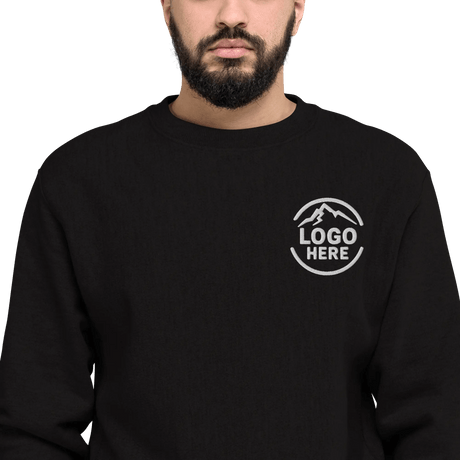
- Custom embroidered sweatshirts are the premium choice for branded fleece. A stitched left chest logo outlasts both screen print and direct to garment, and it gives a raised, professional finish buyers associate with quality.
- Blank weight drives feel and price. Standard heavy blend crewnecks run about 8 oz, midweight cotton rich fleece runs 8.5 to 9.5 oz, and true heavyweight fleece reaches 10 oz or more.
- Embroidery is priced by stitch count, not color count. A standard left chest logo is roughly 5,000 to 10,000 stitches, so small clean logos stay affordable in bulk.
- Fleece needs the right backing. Quality shops use a 2.5 to 3 oz cutaway stabilizer plus a topper so stitches sit crisp on the pile instead of sinking in.
- No minimum order at Arklavo. Order one custom embroidered sweatshirt or a thousand, with free shipping over $150 and most orders moving in 2 business days.
Custom embroidered sweatshirts are crewnecks and hoodies decorated with a stitched thread logo rather than a printed one, and for branded fleece they are usually the smartest decoration method. This buyer's guide walks through the blanks worth ordering, how embroidery pricing actually works, when embroidery beats printing on heavyweight fleece, and how to get a single piece made with no minimum. Everything below is built for businesses outfitting staff, schools, teams, and event crews, not hobby crafters.
Why embroidery suits sweatshirts better than printing
Embroidery suits sweatshirts because thread holds up on thick, brushed fleece where printed ink can crack or feel heavy. A sweatshirt is a knit fabric with a lofty inner face, so a decoration method that sits in the fabric structure rather than on top of it tends to wear better. Stitched thread also reads as more premium. Decorators describe embroidery as giving a raised, textured finish with a slight three dimensional effect that stands off the garment, which is exactly the look corporate and uniform buyers want on a jacket or crewneck.
There is a durability angle too. In side by side comparisons of sweatshirt decoration, embroidery outlasts both print methods, with properly cured screen prints landing second at 50 or more washes and direct to garment third. For a staff uniform or a team hoodie that gets washed constantly, a stitched logo is the safest long term bet. The trade off is that embroidery carries a higher cost per unit, which is the price of that perceived value and longevity.
Hand feel is the other reason embroidery fits fleece so well. On a soft brushed crewneck, a thick ink deposit can sit heavy and stiff, especially across a large print. A modest stitched logo adds almost no weight you notice in normal wear, and it keeps the soft drape that makes a good sweatshirt feel worth its price. The exception is a very high stitch count design with dense fill, which can feel firm in the hand, which is one more reason to keep logos clean rather than overloaded.
If your design is a large full color graphic or a photographic image, embroidery is the wrong tool and printing wins. We cover that split in detail in our DTG vs screen printing guide and the DTF vs DTG comparison. For a logo, a monogram, or text, embroidery is almost always the right call on fleece.
Best blank sweatshirts for embroidery
The best blank for an embroidered sweatshirt depends on the weight and feel you want, which ranges from about 7 oz lightweight fleece to 10 oz heavyweight. Heavier fleece feels more substantial and supports dense embroidery well, while lighter blends keep cost and bulk down. Here is how the common bodies sort out by published fabric weight.
| Blank | Approx weight | Blend | Best for |
|---|---|---|---|
| Bella+Canvas 3901 | ~7 to 7.5 oz | Poly cotton rayon | Soft retail feel, lighter programs |
| Gildan 18000 Heavy Blend | ~8 oz | 50/50 cotton poly | Cost effective bulk workhorse |
| Jerzees NuBlend 562 | ~8 oz | 50/50 cotton poly | Standard mid range fleece |
| Independent Trading SS3000 | ~8.5 oz | 80/20 cotton poly | Midweight cotton rich feel |
| Champion Powerblend | ~9 oz | Cotton poly | Recognized brand, warmer hand |
| Comfort Colors 1566 | ~9.5 oz | 80/20 cotton poly | Thick garment dyed, premium retail |
| Independent Trading IND4000 | ~10 oz | 70/30 cotton poly | Heavyweight streetwear, cold weather |
For most staff and team programs, a roughly 8 oz heavy blend like the Gildan 18000 hits the balance of cost, durability, and a clean surface for stitching. When the sweatshirt is the gift or the retail piece, step up to a cotton rich 9 to 10 oz body so the weight matches the price. You can browse decorated options in our custom men's sweatshirts and women's sweatshirts collections, plus custom hoodies if you want a hood.

How custom embroidery pricing works on sweatshirts
Embroidery is priced mainly by stitch count, so the size and density of your logo, not the number of colors, sets the cost. Every stitch is one needle penetration, so a higher stitch count means more machine time, more thread, and more stabilizer support. A standard left chest logo of about 2.5 to 3.5 inches wide usually lands in the 5,000 to 10,000 stitch range, while a detailed crest or badge can climb to 15,000 stitches or more.
Two practical rules follow from that. First, simple clean logos are cheaper to stitch than busy designs with heavy solid fill, and they also feel softer because there is less thread loading the fabric. Second, because color count does not drive embroidery price the way it drives screen printing, a multi color logo can be economical to embroider as long as the stitch count stays reasonable. Many shops, including ours, also charge a one time digitizing fee to convert your artwork into a stitch file, after which reorders skip that step. For a full breakdown of decoration costs, see our guide on how much embroidery costs.
When you ask for a quote, these are the factors that move the final number:
- Stitch count. The single biggest driver. A clean 6,000 stitch left chest mark costs less per piece than a 14,000 stitch filled crest.
- Digitizing. A one time fee to build the stitch file. Reorders of the same logo skip it entirely.
- Quantity. Even though embroidery has no screen setup, per piece cost still eases at higher volumes because hooping and handling get more efficient across a run.
- Number of logo locations. A left chest plus a sleeve hit is two stitch jobs per garment, not one.
- The blank itself. A 10 oz cotton rich fleece costs more than an 8 oz heavy blend, so the body you pick sets the floor before decoration.
Embroidery vs screen print vs DTG on heavyweight fleece
On heavyweight fleece, embroidery wins for logos and longevity, screen printing wins for large bold graphics at volume, and direct to garment wins for detailed full color art on cotton rich bodies. Each method has a clear lane once you account for how thick fleece behaves.
| Method | Best use on fleece | Durability | Cost driver |
|---|---|---|---|
| Embroidery | Left chest logos, sleeve marks, monograms | Highest, outlasts both prints | Stitch count |
| Screen print | Large front or back graphics, bold branding | Strong at 50+ washes when cured | Colors and run size |
| Direct to garment | Detailed or photographic art, small runs | Good on cotton rich, weaker on synthetics | Garment and print area |
Screen printing is the most cost effective method for orders of 24 or more pieces with one to four colors, because the screen setup cost is fixed and spreads across the run. Direct to garment skips setup and shines for low volumes and complex artwork, but it works best on cotton or high cotton blends and struggles on heavy polyester or very textured fleece. Embroidery sits above both on perceived value, which is why it dominates corporate and uniform programs. If you are deciding across an outerwear program, our custom embroidered jackets guide applies the same logic to shells and softshells.

What separates good sweatshirt embroidery from bad
The difference between crisp and sloppy sweatshirt embroidery is almost always the backing and the digitizing, not the machine. Fleece is knit and stretchy with a brushed pile, so without support the needle action can pucker the fabric and let stitches sink into the loft. Quality shops hoop a cutaway stabilizer behind the design that stays in place permanently to support the stitches for the life of the garment.
For sweatshirts specifically, a medium to heavy cutaway in the 2.5 to 3 oz range is the right choice. Lightweight crewnecks do well with 2.5 oz, while heavy 10 oz fleece calls for 3 oz, and large dense designs may use a double layer. On top of the garment, a water soluble topper keeps the stitches riding above the pile so the logo stays sharp instead of disappearing into the texture. The other half is digitizing. A logo digitized properly for fleece uses the right density and underlay so it holds shape after washing. When you request a sweatshirt order from us, our team checks both before stitching, which is why the proof step matters.
Hooping and registration are the last piece. The garment has to be held flat and square in the hoop so the logo lands straight and centered, and on a bulky crewneck that takes more care than on a flat woven shirt. A rushed hooping job is how you get a logo that sits crooked or a chest mark that drifts off center. Trimming matters too. Clean shops trim jump stitches and loose threads on the back and front so the inside of the sweatshirt does not scratch and the front stays neat. None of this shows up in a quote, but it is the difference between a sweatshirt that looks made to order and one that looks homemade.
Ordering custom embroidered sweatshirts with no minimum
You can order a single custom embroidered sweatshirt at Arklavo with no minimum quantity, which is rare in an industry built around bulk. Most decorators set a floor of 12 to 24 pieces because screen setup or machine setup needs to be spread across a run. We removed that floor so a new business can test one sample, a manager can replace one lost uniform, or a team can order exactly the headcount it has.
The rest of the process is built to be quick. Shipping is free on orders over $150, most orders move in 2 business days, and new customers can take 15 percent off a first order with the code FIRST15. You have two ways to start. Use the online customizer to drop your logo onto a blank and see it live, or request a quote and our team will send a proof, recommend the right blank and backing, and confirm pricing. For larger or mixed programs, the quote path is usually faster because we can spec the whole order at once.
Ready to outfit your team
Get custom embroidered sweatshirts with no minimum
Order one or a thousand. Free shipping over $150, most orders in 2 business days, and 15 percent off your first order with code FIRST15.
Request a quote Browse sweatshirtsWhere to place your logo on a sweatshirt
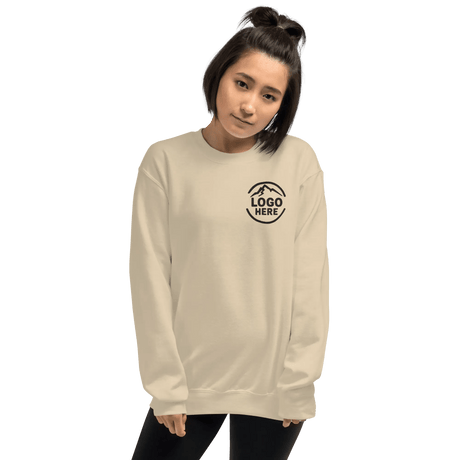
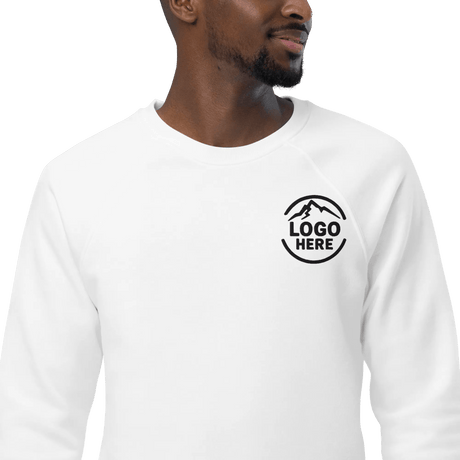
The standard placement for an embroidered sweatshirt logo is the left chest, sized about 3 to 4 inches wide and set roughly 7 to 9 inches down from the shoulder seam. That position reads as professional, matches what people expect on a uniform or corporate crewneck, and keeps the stitch count efficient. It is the placement we default to unless a customer asks for something else.
Beyond the left chest, there are four placements worth knowing. A full back design suits teams and event crews who want the brand visible from a distance, though large dense backs push stitch count and cost up fast, so a back is often better screen printed. A center chest works for a single bold monogram or wordmark. A sleeve hit, usually on the upper arm or forearm, adds a second small brand touch without crowding the chest. A nape mark at the back of the neck is a subtle retail style detail. For staff programs, a left chest logo plus an optional sleeve mark covers almost every need. If you are mixing sweatshirts with other pieces, keep placement consistent across the program so a polo, a hat, and a crewneck all read as one brand. Our custom polo shirts guide uses the same left chest standard.
Matching thread color to your brand
Embroidery matches brand colors by selecting the closest thread shade from a fixed thread palette, so your exact Pantone may be approximated rather than reproduced perfectly. Unlike ink, which can be mixed to a precise formula, embroidery thread comes in a set range of stocked colors. Good shops map your brand colors to the nearest thread using a manufacturer color chart, then show you the match on a proof before stitching. For most logos the nearest thread is visually indistinguishable from the target, but it is worth approving rather than assuming.
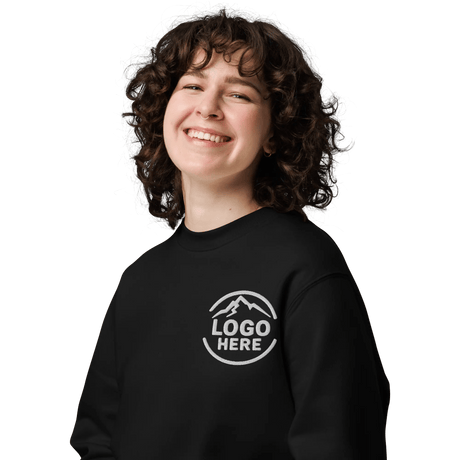
A few practical notes. Light thread on dark fleece reads with high contrast and looks sharp, which is why many brands use a white or cream version of their mark on a navy or charcoal sweatshirt. Very fine gradients, neon, and metallic effects are limited in thread, so a logo built for screen or digital print sometimes needs a simplified embroidery version. If your logo has thin text under about a quarter inch tall, it can stitch muddy at small sizes, so we may recommend bumping the size slightly or simplifying the lockup. We handle that conversion during digitizing and flag anything that will not stitch cleanly.
Lead times, proofs, and reordering
Most custom embroidered sweatshirt orders ship in 2 business days, with the first order including a one time digitizing step and a proof for approval. Digitizing is the process of turning your logo file into a stitch file the machine can read. It happens once. After your design is digitized and approved, the stitch file is saved, so reorders skip that step and are both faster and cheaper.
The proof is the most important checkpoint. Before we stitch a full run, you see a digital proof showing the logo, its size, its placement, and the thread colors mapped to your brand. That is the moment to catch a color that drifted or text that is too small. Approving the proof locks the spec. For programs that reorder on a schedule, like a restaurant adding crewnecks every quarter as it hires, the saved stitch file keeps every batch identical to the first, which is something printed methods cannot always promise as the garment ages. Complex digitizing or very large quantities can extend the timeline, so confirm your in hands date when you request a quote.
Sizing and color choices for a team order
Because there is no minimum, you order the exact size run your team needs instead of buying a fixed pack and over ordering. That is the practical advantage of no minimum embroidery for a real business. You can mix sizes from extra small through the larger end of the range, mix men's and women's cuts, and even mix a couple of colors in a single order, all decorated with the same logo.
Two decisions usually come up. First, cut: a unisex crewneck fits most staff programs and simplifies sizing, while a women's cut gives a more tailored fit if your team prefers it. Browse both in our men's and women's sweatshirt collections. Second, color: darker bodies hide wear and pair well with light thread, while a heather grey is the safe neutral that suits almost any logo. If your program spans more than sweatshirts, the same no minimum approach runs across our full apparel range, from t-shirts to hats, so you can build one consistent look.
Common mistakes to avoid with embroidered sweatshirts
Most embroidered sweatshirt problems trace back to a handful of avoidable decisions made before stitching starts. After thousands of fleece orders, the same issues come up, and all of them are easy to prevent at the proof stage.
The first is using a logo built for print without simplifying it for thread. A design with fine gradients, tiny text, or dozens of thin elements can stitch muddy, so it needs an embroidery version. The second is text that is too small. Lettering under about a quarter inch tall loses definition in thread, so it is better to size up or drop the tagline. The third is skipping the proof. The proof exists to catch a thread color that drifted or a placement that is off, and approving it takes a minute that saves a reprint.
The fourth is mismatching the blank to the logo. A heavy filled design on thin lightweight fleece can pull and pucker, so dense logos belong on a sturdier 8 oz or heavier body with the right cutaway backing. The fifth is treating digitizing as a recurring cost. It should be a one time fee, after which your saved stitch file makes every reorder identical and cheaper. When you order custom embroidered sweatshirts through us, our team raises any of these before the run so you are not surprised by the result.
A note from our founder
When we started Arklavo, the complaint I heard most from small business owners was the minimum order. They wanted ten embroidered crewnecks for a new hire group, and a supplier told them to buy forty eight. That gap is why we run no minimums. On sweatshirts in particular, I push our team toward embroidery for logos because I have watched too many printed fleece pieces crack at the fold after a season of washing, while a stitched logo from the same period still looks new. Spend the extra on thread, keep the logo clean, and the garment earns its keep. That is the whole philosophy. If you are weighing a sweatshirt program for your team, send us the logo and the headcount, and we will tell you honestly whether embroidery or print is the right call before you spend a dollar.
Frequently asked questions
Is embroidery or printing better for sweatshirts?
Embroidery is better for logos, monograms, and text on sweatshirts because thread holds up on thick fleece and outlasts both screen print and direct to garment. Printing is better when your design is a large full color graphic or a photograph, since those are hard to reproduce in thread.
How much does it cost to embroider a sweatshirt?
Cost depends on stitch count rather than colors. A standard left chest logo of 5,000 to 10,000 stitches is the affordable baseline, and larger or denser designs cost more. Most shops also add a one time digitizing fee to create the stitch file, which reorders then skip. Request a quote for exact pricing on your logo and quantity.
Can I order just one embroidered sweatshirt?
Yes. Arklavo has no minimum order, so you can buy a single custom embroidered sweatshirt. Most competitors require 12 to 24 pieces because they spread setup across a run, but we removed that floor.
What is the best blank sweatshirt for embroidery?
For value and durability, a roughly 8 oz heavy blend crewneck such as the Gildan 18000 is a reliable default. For a premium feel, step up to a cotton rich 9 to 10 oz body like Comfort Colors 1566 or an Independent Trading heavyweight. All embroider well with the right backing.
Why does embroidered fleece need a stabilizer?
Fleece is a stretchy knit with a brushed pile, so a cutaway stabilizer of about 2.5 to 3 oz is hooped behind the design to keep the fabric from puckering and the stitches from sinking. A water soluble topper on top keeps the logo crisp above the pile. Without both, sweatshirt embroidery distorts.
How long do custom embroidered sweatshirts take to ship?
Most Arklavo orders move in 2 business days, and shipping is free over $150. Timelines can vary with large quantities or complex digitizing, so confirm your in hands date when you request a quote.
Do you offer embroidered hoodies as well as crewnecks?
Yes. The same embroidery process applies to hoodies and crewnecks. Browse our custom hoodies alongside the sweatshirt collections, and see our custom Champion hoodies options for a branded body.
Related guides
- Custom embroidered jackets with no minimum
- How much does embroidery cost
- DTG vs screen printing
- Custom embroidered hats with no minimum
- Custom polo shirts with logo, no minimum
Sources
- Bolt Printing, hoodie and sweatshirt fabric weight ranges
- Hem Apparel, fabric weight to GSM guide
- Printful, embroidery cost driven by stitch count
- Rare Custom, sweatshirt decoration durability and cost comparison
- GPI Supplies, best stabilizer weight for sweatshirts
- Ricoma, embroidery stabilizer selection guide
- Melco, selecting stabilizer backing by fabric and density