Custom Apparel Guide · 9 min read
Embroidered vs Patch Hats: Which Logo Style Wins?
Key takeaways
- Embroidered hats and patch hats both look sharp, but they suit different jobs. Direct embroidery is the most durable and most budget friendly for bold logos, woven patches handle fine detail and a structured look, and leather patches deliver a premium feel for one bold mark. This guide compares durability, logo detail, color accuracy, cost, and the best hat types so you can pick the right method for your team.
When your business orders branded hats, the style of the logo matters as much as the hat itself. Arklavo offers both decoration methods on the same hat styles, so the comparison below is about fit for purpose rather than what we happen to stock. Two methods dominate the market for professional headwear: direct embroidery, where thread is stitched straight into the hat fabric, and patch decoration, where a pre-made patch is applied to the hat surface. Arklavo's custom hats collection stocks styles built for both embroidery and patch application, so you can compare in person.
Within the patch category there are two main types: woven patches and leather patches, each with a different look and a different price point. Choosing between these three approaches changes the durability, the visual result, the cost per unit, and the settings the hat actually works in. This guide breaks down what each method does and which one fits which team.
At a glance
100+
Wash cycles embroidery survives
97%
Say uniforms make staff easier to identify
3
Main logo methods compared
$0
Setup fees at Arklavo
About this comparison: Decoration methods, typical pricing ranges, and durability data reflect publicly available industry information as of June 2026. This article compares decoration techniques, not specific brands. Individual suppliers set their own pricing and lead times, which may differ from the figures discussed here. Always confirm details with your chosen supplier before placing an order.
What is direct embroidery on a hat and how durable is it?
Direct embroidery means a machine stitches thread directly through the hat fabric using a digitized version of your logo. There is no separate piece applied on top: the artwork becomes part of the hat itself.
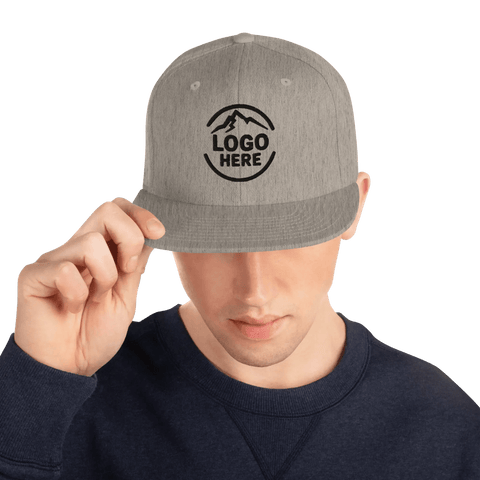
The thread is typically polyester or rayon, stitched in multiple layers to build up color, depth, and texture. On a structured hat like a six-panel cap or a snapback, the front panel is stable enough for the embroidery hoop to grip cleanly, which produces tight, consistent stitching across a full production run.
Durability is the main reason teams choose direct embroidery for workwear and uniforms. Because the logo is woven into the fabric rather than adhered to its surface, it does not peel, crack, or lift at the edges. Embroidered logos routinely survive more than 100 wash cycles while maintaining their appearance, compared with screen-printed decoration that typically starts to degrade between 40 and 60 washes.1 For hats used daily in food service, outdoor trades, or sports, that difference matters across an entire season of washing.
The main limitation of direct embroidery is fine detail. Very thin lines, gradients, and photographic elements do not digitize cleanly into thread. A logo with bold shapes and clear color blocks works well. A logo with tiny text below about 4 millimetres tall or complex color transitions needs to be simplified before it goes on a hat. A reputable embroiderer will catch these issues at the proof stage rather than letting a flawed stitch go into production.
What is a woven patch on a hat and when does it make sense?
A woven patch is a pre-made textile label, usually cut into a standard shape such as a rectangle, shield, or circle, that carries your logo woven directly into its fabric.
The weave is tighter than embroidery and can reproduce finer detail: thin lines, small text, and multi-color designs with closely spaced elements translate better in a woven patch format than they do as direct thread stitching. The finished patch is then attached to the hat, either sewn around its perimeter or heat-sealed on the back, depending on the supplier and the hat material.
Woven patches give a structured, label-like appearance that reads well on casual and lifestyle headwear. A snapback or five-panel hat with a woven patch on the front panel or side has an aesthetic closer to streetwear and retail fashion than to traditional corporate or workwear branding. This makes the format a strong fit for brands in coffee, craft beverage, outdoor recreation, and similar lifestyle categories where the hat is part of the product range as much as it is a uniform piece.
On durability, woven patches are more vulnerable than direct embroidery at the edges. A sewn-on patch with clean stitching around its full perimeter holds up well through repeated washing. A heat-sealed patch or a patch with loose edge stitching will eventually lift at the corners, particularly in humid or high-heat environments. If the hat goes through industrial laundering or daily outdoor use, a woven patch needs to be anchored properly to last a full season.
What is a leather patch on a hat and what look does it produce?
A leather patch is a small piece of genuine or synthetic leather, laser-engraved or debossed with a logo, and attached to the front panel of a hat. The material can be full-grain leather, suede, or a vegan alternative, and the logo is burned into the surface rather than printed or stitched. The result is a premium, muted aesthetic: the design shows as a darker impression in the material rather than a color graphic, giving the hat a handcrafted and artisan quality.
Leather patches suit brands in premium food and beverage, hospitality, outdoor recreation, and craft industries where the aesthetic cue of the material itself communicates quality. A brewery, a boutique hotel, a craft coffee roaster, or a fishing guide service tends to find a leather patch hat reads as more intentional and premium than a standard embroidered logo. The patch also ages visibly: genuine leather develops a patina over time, which reinforces the handcrafted story for some brand categories.
The limitations are real. Leather patches are the most expensive of the three methods, typically adding a meaningful cost per unit over direct embroidery, and they are harder to produce at large scale without variation between patches.
Logo detail is also limited: the engraving or deboss works well for bold single-color marks but cannot reproduce multi-color graphics or fine photographic detail. If your logo depends on a specific set of brand colors, a leather patch will render it as a tone-on-tone impression, not a color match.
Embroidered vs patch hats: side-by-side comparison
The table below compares all three major hat decoration methods across the factors that matter most for a business order: durability, logo detail, typical cost premium, and best use case.
| Factor | Direct Embroidery | Woven Patch | Leather Patch |
|---|---|---|---|
| Durability | Highest: stitched into fabric, 100+ wash cycles | Good if sewn perimeter; heat-sealed edges lift over time | Good for genuine leather; synthetic patches vary |
| Logo detail | Bold shapes and clear color blocks: excellent. Fine lines and text below 4mm: limited | Fine detail and small text: better than direct embroidery | Bold single marks only: no multi-color reproduction |
| Color accuracy | Thread matched to brand colors, up to 12 colors typically | Multi-color woven thread, close match to original | Tone-on-tone only: no color match possible |
| Cost premium | Lowest of the three at comparable unit counts | Moderate: patch production adds cost, especially on small runs | Highest: material and laser or deboss process both add cost |
| Visual style | Classic, textured, raised: suits corporate, hospitality, sports | Structured label: suits lifestyle, retail, casual streetwear | Premium, artisan, aged: suits craft, outdoor, boutique brands |
| Best hat types | Structured caps, snapbacks, dad hats, beanies | Snapbacks, five-panels, trucker hats | Dad hats, trucker hats, snapbacks with flat front panel |
| Minimum order | No minimum at Arklavo | Patch setup may require a minimum patch run from supplier | Patch setup may require a minimum patch run from supplier |
Key point: Around 97% of people say uniforms and branded apparel make staff easier to identify.2 The decoration method you choose affects whether that logo holds up through a full season of use.
Which decoration method is right for your team?
The right choice depends on what the hat is for, how often it gets washed, what your logo looks like, and how much the premium aesthetic matters to your brand.
Choose direct embroidery if: your hats will be worn daily in active settings, washed regularly, or used in food service and outdoor trades. If your logo has solid shapes and clear colors, embroidery produces the cleanest, most durable result for the price. It is also the most consistent across large production runs because there are no separate patch components to source. For most team and corporate orders, direct embroidery is the default choice because it performs reliably over time without edge lifting or material degradation.
Choose a woven patch if: your logo has fine text, tight detail, or many closely spaced colors that would not digitize cleanly into thread. Woven patches are also worth considering if you want the label-style aesthetic for a lifestyle or retail brand, and if the hat is not going into heavy daily laundering. Confirm with your supplier that the patch is sewn rather than just heat-sealed if the hats will be washed frequently.
Choose a leather patch if: your brand story centers on craft, artisan quality, or premium outdoor products, and your logo works as a bold single-color mark. Leather patches read immediately as polished and intentional. The higher cost per unit is justified when the hat is a premium retail item or when the brand positioning calls for that material cue. If your logo depends on specific colors, a leather patch is not the right format because it cannot reproduce them.
How we handle hat decoration at Arklavo
At Arklavo our primary hat decoration method is in-house embroidery. We digitize your artwork, set up the machine, and produce a free digital proof before any thread goes through a hat. That proof shows exactly how the stitch will lay out: color mapping, stitch direction, and placement. If the digitizing reveals a fine-detail issue with your logo, we catch it at the proof stage and work with you to simplify the artwork before it causes a problem on the finished product.
We do not enforce an order minimum. If you need 6 hats for a small crew or 200 hats for a large team rollout, the process is the same: submit your logo, review the proof, approve, ship.
Free shipping applies to orders over $150. Most orders ship within two business days of artwork approval. We have served more than 13,000 businesses since 2023, and the most consistent feedback we get is that the embroidered logo holds up through the season without the fading or peeling that frustrated teams with printed alternatives.
If you want to browse the styles we currently offer, our custom embroidered hats collection shows the full range of structured caps, dad hats, snapbacks, and trucker styles available for embroidery decoration. Each style page includes hat construction details and the available color options so you can match the blank to your brand palette before we start on the logo.
No minimum, free shipping over $150
Get a free quote on embroidered hats, no minimum
No setup fees. Free digital proof before production. In-house embroidery with free shipping over $150. We handle orders from a single hat up to large team runs, and your quote comes back fast with no obligation.
Sources
- NW Custom Apparel. "Embroidery vs Screen Printing for Uniforms." Accessed June 2026. nwcustomapparel.net
- Cintas. "Your Uniform's Branding Power: Turning Business Apparel Into a Strategic Asset." Accessed June 2026. cintas.com
Keep reading
Beanies take an embroidered logo cleanly too, and the knit cuff is a natural home for a stitched mark; you can see the styles we stock in our embroidered beanies collection.
See the full range before you read on
Every style, current price and decoration option in one place, so you can shortlist while the detail is fresh.
No minimum order
Compare styles and prices in one place
Every blank, weight and decoration option side by side, with current listed prices.
The value pick from this guide

No minimum order. Free digital proof before anything is made.
No minimum order. See your logo on the real product first.
Every price is listed. Free proof before anything is made.
Ordering for a team?
Get a quote for your whole team
You have seen the prices already, so a quote here is arithmetic, not a sales call. Send your quantities, sizes and product and we total the program from the same listed prices in this guide. No setup fees, no minimums.
Get a QuoteIs direct embroidery more durable than a patch on a hat?
Yes, in almost all conditions. Direct embroidery is stitched into the hat fabric itself and has no edges that can lift or delaminate. It routinely survives more than 100 wash cycles with no visible fading. A well-sewn woven patch with a stitched perimeter comes close, but any patch method introduces an adhesive or stitched edge that is a potential failure point under sustained washing. For daily-use workwear, direct embroidery is the more reliable long-term option.
Can embroidery reproduce the same detail as a woven patch?
Not always. Direct embroidery has a lower limit on fine detail: text below about 4 millimetres tall and very thin lines can lose clarity because the stitch needle is wider than a print or weave thread. Woven patches are produced on specialized looms that can weave finer lines and tighter detail than machine embroidery. If your logo has small text or complex fine linework, a woven patch will reproduce it more cleanly. Bold, simplified logos work equally well in both methods.
Are leather patch hats more expensive than embroidered hats?
Yes, typically. Leather patches require sourcing the material, laser engraving or debossing the logo, and then attaching the patch to the hat. Each of those steps adds cost compared with digitizing a logo and stitching it directly. The premium is meaningful on small runs, where patch setup costs are spread across fewer units. At high volumes the per-unit gap narrows, but direct embroidery remains the lower-cost option in most scenarios.
Which logo style looks best on a structured cap versus a dad hat?
Structured caps have a stiff front panel that holds the embroidery hoop firmly, which makes them ideal for direct embroidery with clean, even stitching across the whole design. Dad hats have a softer, unstructured front panel that can shift slightly during hooping, making them better suited to smaller, simpler embroidery designs or a patch applied with a stiff backing material. If you want a large, detailed embroidered logo, a structured hat is the safer choice for consistent results across a run.
Do patch hats fall apart when washed frequently?
It depends on the attachment method. A woven or leather patch sewn around its full perimeter with tight stitching holds up well through regular machine washing. A patch that is only heat-sealed, or one with loose edge stitching, will eventually lift at the corners, particularly in hot water or with tumble drying. If the hats will be laundered regularly, ask your supplier whether the patches are fully sewn down, and wash on a gentle cool cycle to extend the life of any patch decoration.
Can I order a small number of embroidered hats without a minimum?
At Arklavo, yes. There is no order minimum on embroidered hats. You can order as few as one hat or as many as several hundred, and the process is the same either way: submit your logo, get a free digital proof, approve, and ship. This is the most common point of friction for small business owners used to promo suppliers that require bulk quantities. For most team orders, five to fifteen hats is a typical first run.
What is the best logo decoration for a restaurant or hospitality team?
Direct embroidery is the standard choice for food service and hospitality. The logo is stitched into the hat so it survives the repeated washing that kitchen and front-of-house headwear goes through. There are no edges to lift and no surface coating to crack near steam or heat. Woven patches are an alternative if your logo has fine detail that does not digitize cleanly, but in most restaurant settings the practicality of direct embroidery outweighs the slight aesthetic difference.
Which type of branded hat decoration holds color best over time?
Direct embroidery holds color best. Polyester and rayon thread resist UV fading better than most surface-applied decorations, and because the logo is stitched rather than printed or adhered, there is no dye layer to bleach out. Woven patches also hold color well because the thread is woven into the patch substrate rather than printed on top of it. Leather patches do not apply to color holding because the engraving or deboss is tone-on-tone by design. Screen print or heat-transfer alternatives fade significantly faster than any of the three methods compared here.
How small can text go on an embroidered hat logo?
Text below roughly 4 millimetres tall does not stitch cleanly and needs to be simplified before it goes on a hat. The same applies to very thin lines, gradients, and photographic elements, which do not digitize cleanly into thread. A reputable embroiderer will catch these issues at the proof stage rather than letting a flawed stitch go into production.
What thread is used for direct embroidery on a hat?
The thread is typically polyester or rayon, stitched in multiple layers to build up color, depth, and texture. On a structured hat such as a six-panel cap or a snapback, the front panel is stable enough for the embroidery hoop to grip cleanly, which is what produces tight, consistent stitching across a full production run.
Every price is on the page. No form first.
No minimums, no setup fees, free proof.
Get a free quote
Priced from the listed prices on this page
Request sent
Keep browsing while you waitThat did not send
Something blocked the request on our side. Send it through the quote page and we will pick it up there.
Open the quote page