Custom Apparel Guide · 13 min read
Company Polo Shirts Buying Guide for Businesses
You're probably dealing with one of two situations right now. Arklavo produces custom polos in 2 days, then ships in 2 to 5 business days. Either you're opening a new location and need uniforms fast, or your current polos looked fine on day one and tired by month two. The collar curled, the logo cracked, half the team asked for exchanges, and reordering for new hires turned into a spreadsheet problem.
That's why company polo shirts deserve more thought than most businesses give them. A polo sits in the middle of brand image, staff comfort, wash durability, and budget control. It has to work for the person behind the front desk, the manager moving between locations, and the owner watching replacement costs. The wrong fabric or decoration method usually doesn't fail in the mockup. It fails after repeated wear, real sweat, and commercial laundering.
If you're comparing options, explore custom polo shirts to see the kind of range businesses usually need, from basic staff uniforms to branded front-of-house programs.
Table of Contents
- Introduction to Company Polo Shirts Buying Guide
- Materials and Fabric Performance
- Fit and Sizing Guidance
- Decoration Methods Embroidery vs Printing
- Brand Quality and Budget Trade-Offs
- Ordering Process Production Timelines and Reorders
- Industry-Specific Recommendations and Next Steps
- FAQs
Introduction to Company Polo Shirts Buying Guide
A typical owner starts with a simple goal. Get the team into matching polos that look professional, feel comfortable, and don't wreck the budget. Then the trade-offs show up. Cotton feels better at first touch, but some teams run hot. Polyester performs better in active roles, but some office-facing teams prefer a softer handfeel. Embroidery looks sharper, but printed graphics can suit larger artwork.
That's why a custom t-shirt buying guide for businesses matters. The global workwear market reached $178 billion in 2023, with 65% of U.S. small-to-mid-sized businesses adopting branded polo shirts as uniforms, and average unit costs ranging from $12 to $25 including embroidery or screen printing. Those figures put company polo shirts in the middle of a very active purchasing category, not a niche side item.
Practical rule: Buy polos for the job they'll actually do, not for how they look in a product photo.
The expensive mistake isn't always choosing the highest price. More often, it's choosing a shirt that doesn't match the work environment, then replacing it too soon.
Materials and Fabric Performance
Fabric decides whether a polo becomes a uniform people wear or one they keep tugging at all shift. When buyers focus only on color and logo placement, they miss the part that controls heat, structure, and how well the shirt survives repeat washing.
How fabric choice changes day-to-day wear
For corporate uniforms, 165 to 200 gsm pique cotton balances structure, breathability, and embroidery compatibility, while advanced polyester fabrics wick moisture more aggressively for high-heat work, as noted in practical industry guidance. That one spec range tells you a lot. It gives enough body to support a chest logo cleanly, but it doesn't feel overly heavy for indoor wear.
Pique cotton works because of its knit texture. It hides minor wear better than smoother fabrics, holds a collar more cleanly, and handles embroidery without the logo puckering as easily. For hospitality hosts, retail associates, church staff, and front-desk teams, it's usually the safest all-around choice.
Polyester performance polos serve a different purpose. If the role involves movement, heat, sunlight, or long periods outdoors, moisture management starts to matter more than natural fiber feel.
A lot of businesses are also trying to align uniforms with broader brand values. If sustainability is part of that conversation, it helps to think beyond fabric labels and consider how uniforms fit into a wider strategy for practical planning examples. A shirt that lasts longer often supports that goal better than one that only sounds eco-friendly on paper.
Fabric comparison at a glance
| Fabric Type | Weight (gsm) | Pros | Cons |
|---|---|---|---|
| Pique cotton | 165–200 | Breathable, structured, embroidery-friendly, classic uniform look | Can hold moisture more than performance polyester in hot active roles |
| Single jersey | 190–220 | Smoother handfeel, good for promotional use, softer surface | Less structure for long-term uniform wear |
| Performance polyester | Qualitatively varies | Strong moisture management, better for heat and active work, fast drying | Handfeel can be less natural, some styles look more athletic than corporate |
| Heavy interlock | 210–240 | Shape retention, smoother dense texture, anti-wrinkle feel | Can feel too substantial for hot indoor settings |
A polo that feels great folded on a desk can still fail on a busy shift. Check how it behaves with sweat, movement, and repeated laundering.
When in doubt, match fabric to environment first, logo method second, and color third. That order prevents most uniform disappointments.
Fit and Sizing Guidance
Most returns don't happen because the shirt is badly made. They happen because one team member ordered for a fitted look, another ordered for layering, and a manager guessed the size spread from memory.
How to size a team without creating returns
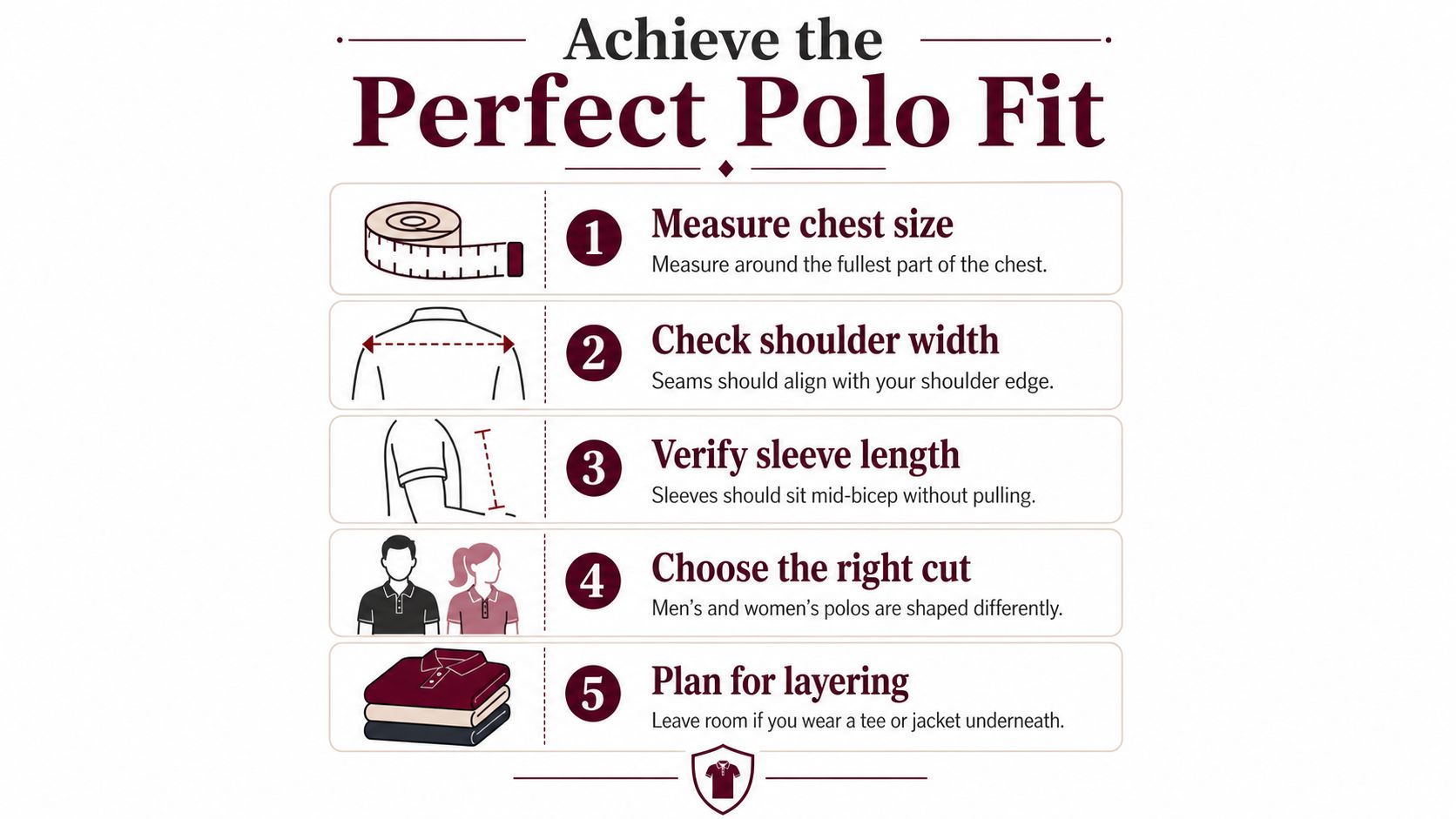
Start with actual measurements, not existing T-shirt habits. A polo fits differently through the shoulder, chest, sleeve opening, and body length. That matters even more when the shirt will be tucked, layered under a jacket, or worn through a full service shift.
Use a simple sequence:
- Measure the chest at the fullest point with the tape level.
- Check shoulder width from seam point to seam point on a shirt that already fits well.
- Review sleeve length so cuffs don't flare or pinch.
- Confirm body length if staff members will bend, reach, or tuck the shirt.
- Ask about layering before the final order, especially for drivers, facilities teams, and cooler indoor spaces.
Gender-specific cuts can help, but they shouldn't be automatic. Some staff prefer a straighter unisex fit for comfort. Others need a shaped cut to avoid excess fabric through the waist and shoulder. The cleanest process is to provide options, then let wearers choose within approved styles.
A simple fit checklist for managers
Use this before placing a team order:
- Compare brand charts: Under Armour, Gildan, and Adidas don't fit exactly the same, even in the same labeled size.
- Order test samples: One sample run prevents a wave of exchanges later.
- Plan for shrinkage and use: If the team launders at home, leave sensible room instead of chasing a fashion fit.
- Standardize role-based fits: Front desk, kitchen expo, field service, and office staff often need different fit preferences.
- Use one chart across the team: Let staff find the right polo size before approvals are locked.
The best sizing system is boring. That's a good thing. If nobody talks about fit after delivery, the process worked.
Decoration Methods Embroidery vs Printing
Decoration is where many polo programs lose money. Buyers compare the cost per shirt, approve a clean mockup, and assume the decision is done. It isn't. The critical question is how the logo will look after repeated wear in your actual work environment.
Where embroidery wins and where printing wins
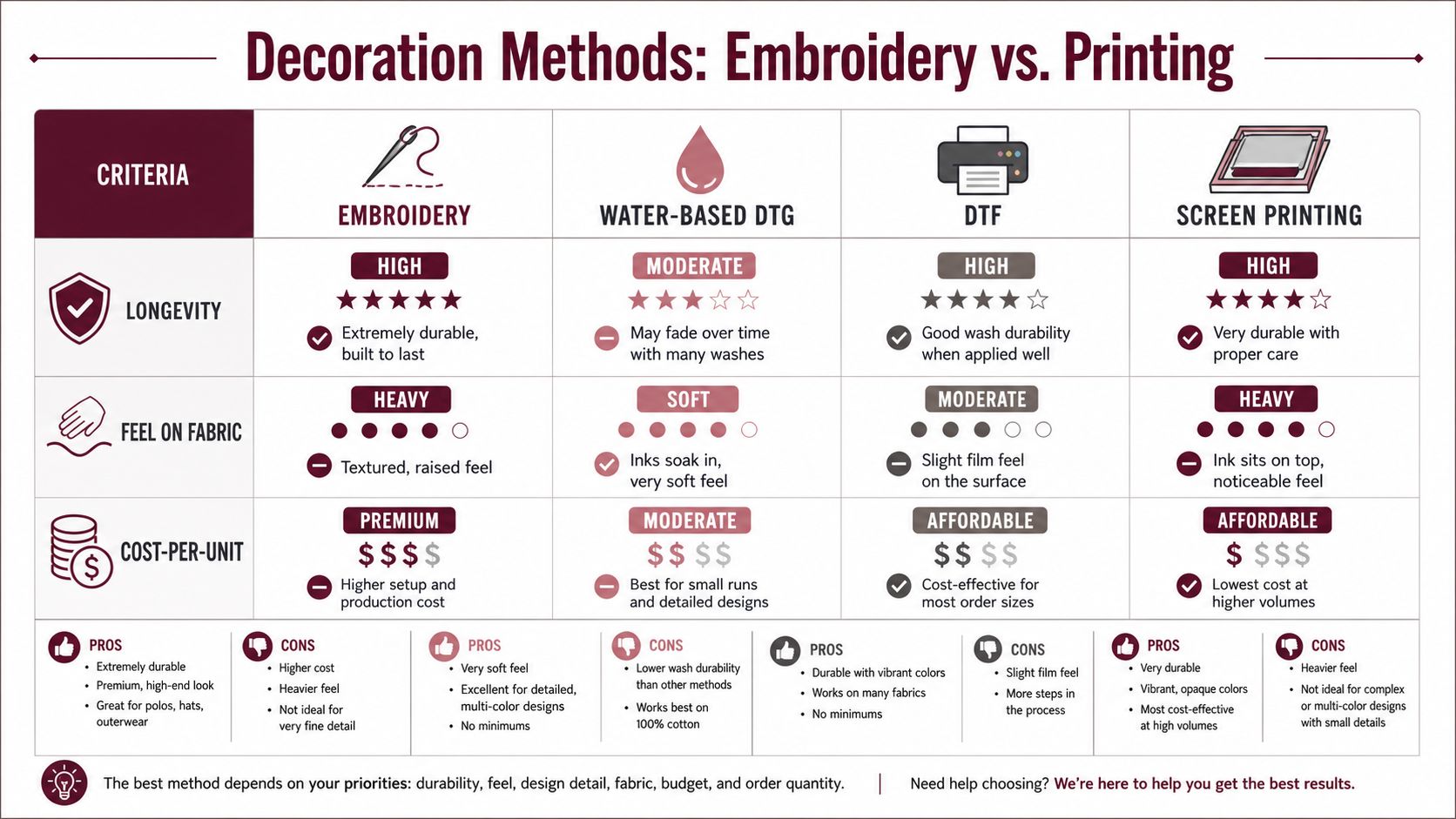
Embroidery is still the default for many company polo shirts because it solves the most common business need. It looks professional, holds up well, and suits chest logos on textured fabrics like pique. For hospitality, office staff, retail supervisors, and service managers, it usually creates the cleanest long-term result.
Printing works when the artwork calls for it. If your logo has fine gradients, a larger back graphic, or a small run where stitch setup feels excessive, print methods can make more sense. But the method matters.
According to this market analysis, DTG prints often crack or fade within 12 to 15 washes in high-abrasion settings, whereas embroidery retains integrity for 3 to 5 years, which changes the true cost-per-wash calculation. That gap becomes very visible in plumbing, auto repair, groundskeeping, warehouse handling, and any role involving friction, repeated laundering, or contact with counters and equipment.
Here's the practical breakdown:
- Embroidery: Best for left-chest branding, repeat wash durability, and a more formal look.
- Water-based DTG: Better for softer-feel graphics on suitable garments, but less ideal where abrasion is routine.
- DTF: Useful for detail and flexibility across garments, though handfeel and long-term wear can vary.
- Screen printing: Strong option for bold graphics and larger placements, especially when the artwork is simple.
Shop-floor advice: If staff lean against surfaces all day, don't judge decoration from the proof. Judge it from wash life and abrasion.
The right choice also depends on logo size. A small chest mark usually benefits from embroidery. A large back print with multiple colors may not.
Think in cost per wash, not just cost per piece
This is the part competitors often skip. A lower upfront decoration price can become the expensive choice if the logo degrades quickly and forces replacement. Even without forcing a strict formula, the decision framework is simple:
| Method | Best use | Main strength | Main caution |
|---|---|---|---|
| Embroidery | Uniform chest logos | Long-term durability, premium appearance | Less suited to highly detailed or very large graphics |
| Water-based DTG | Soft-feel art on compatible garments | Detail and lighter print feel | Reduced life in abrasive work settings |
| DTF | Complex artwork and flexible application | Good detail reproduction | Film feel can be noticeable on polos |
| Screen printing | Bold simple graphics | Clean color coverage | Not always ideal for textured pique surfaces |
If your business replaces uniforms often because of turnover, print may still be the right answer for certain roles.
Brand Quality and Budget Trade-Offs
Not every team needs a premium performance polo. Not every team should buy the cheapest option either. The smart buy sits where brand expectation, daily wear conditions, and replacement risk meet.
When to spend more and when not to
If your staff spends the day face-to-face with clients, premium details matter more. Collar shape, drape, stitching, and color retention all show up in person. That's where brands like Under Armour or Adidas can make sense, especially when moisture management or a more technical look suits the role.
Gildan remains a practical value option for many programs, particularly when budget control matters and the work doesn't demand a premium athletic fabric. It's often enough for volunteer wear, back-of-house roles, and short-cycle staff programs where replacement planning is built in from the start.
A good buying split often looks like this:
- Spend more for client-facing managers, outside reps, studio coaches, and hospitality leads.
- Save strategically for large support teams, temporary events, or roles with very high wear and frequent replacement.
- Standardize the logo treatment even when the base garment differs by role.
What quality standards actually matter
The details that protect a uniform budget are rarely glamorous. According to available industry guidance, ISO and AATCC testing standards ensure colorfastness and durability, and heavy fabrics in the 210 to 240 gsm range reduce replacements by maximizing shape retention and stain resistance.
That matters in plain business terms. A heavier interlock or similarly sturdy knit can hold its shape better when teams wash hard, wear radios, carry pens, or work around dust and grime. In construction offices, automotive service counters, and logistics settings, that can be more valuable than a lighter shirt that looked smoother on day one.
Don't buy “premium” based on the logo at the neck. Buy based on collar recovery, color hold, and whether the shirt still looks uniform after repeated use.
The best budget decision isn't the lowest line item. It's the option that avoids avoidable replacement.
Ordering Process Production Timelines and Reorders
A smooth polo program isn't just about choosing the right shirt. It's about building an ordering system that doesn't fall apart when a new hire starts, a second location opens, or a manager needs six polos sent to three addresses by Friday.
A workflow that prevents expensive mistakes
The most reliable ordering process starts before anyone uploads a logo. First, decide the role categories. Front-of-house, management, field staff, and admin teams often shouldn't all wear the exact same polo. They can still look consistent while using different fabrics or fits.
Then move through the order in a fixed sequence:
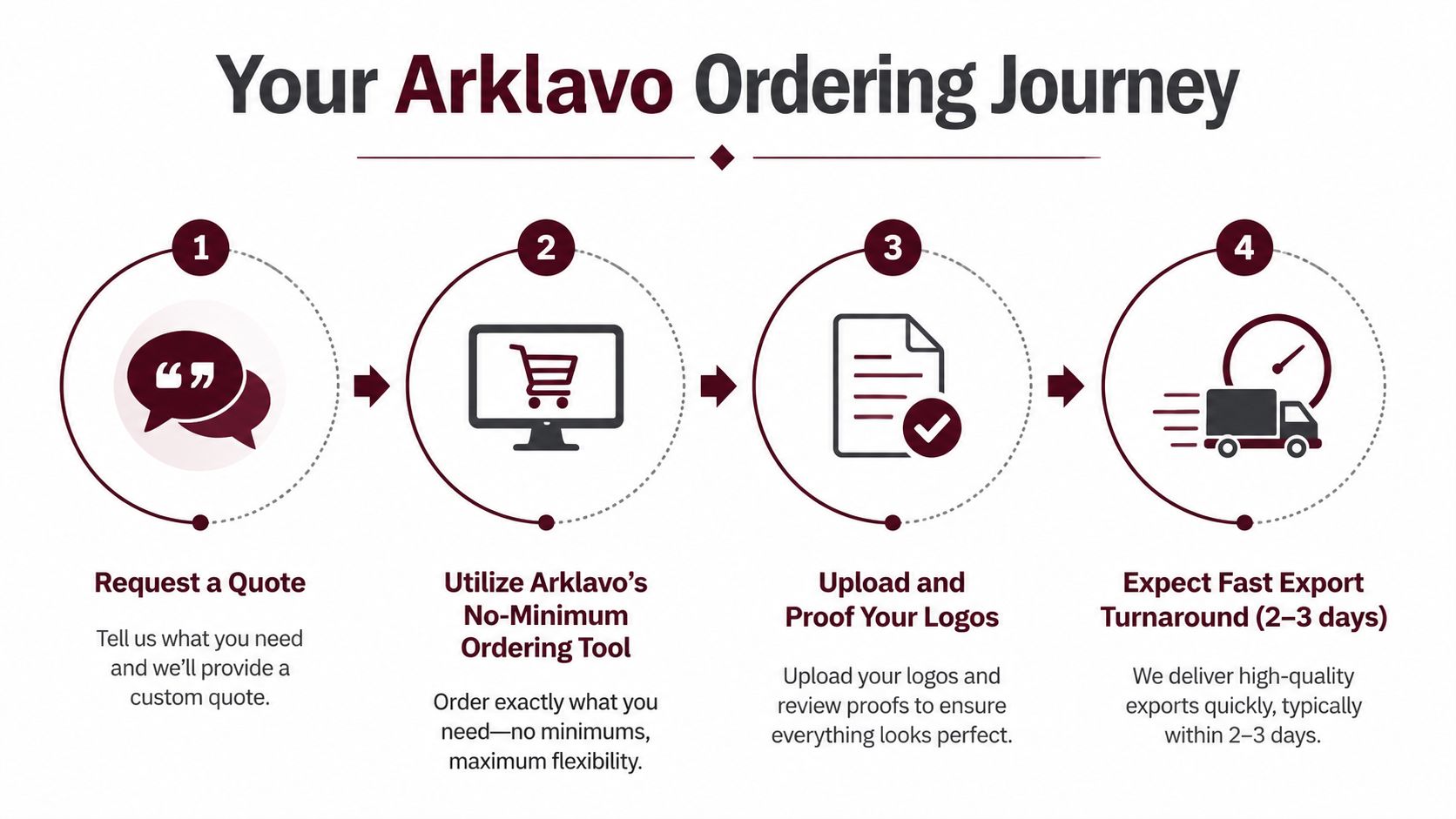
- Request the quote early. Confirm garment options, decoration method, color choices, and where each role sits in the budget.
- Lock the garment before the logo. Too many teams approve art first and realize later the chosen polo doesn't suit the work.
- Use proofing carefully. Check logo size, thread or print color, placement height, and whether left-chest or sleeve branding makes more sense.
- Approve with reorder logic in mind. Save naming conventions, garment codes, and role assignments so future managers don't rebuild the order from scratch.
For businesses that need flexibility, one available option is a supplier workflow with no minimums, saved artwork, and direct shipping by location. That kind of system matters more than people expect because uniform programs rarely end after the first batch.
How to handle multi-location rollouts
Multi-location ordering usually fails in one of three places. Different managers choose slightly different shirt shades, logo placements drift over time, or new staff get added with no clean reorder path.
The fix is operational, not creative.
Set one approved standard for each role category. That means one exact polo model, one exact logo treatment, and one approved color choice per role. If you need location differentiation, use a second placement or a name/title solution, not a different shirt body every time.
A practical rollout checklist:
- Create a role matrix: Match each job type to one approved polo and one decoration method.
- Centralize artwork files: Keep one approved logo file and one proof history.
- Assign a single point of approval: One manager should sign off final art and garment standards.
- Ship by destination: Send direct to stores, clinics, churches, or job sites instead of bulk shipping everything to one office for redistribution.
- Track seasonal needs: Hospitality peaks, school calendars, and outdoor work seasons affect when orders get congested.
Businesses with urgent launches also need realistic production expectations. Arklavo's process includes free logo setup, proof approval, no minimum ordering, and quality-checked production typically in 2 to 3 days, with shipping options that vary by destination.
How to make reorders easy for new hires
Reorders should feel routine. If they feel like a new project every time, the system is broken.
The simplest setup keeps four things on file:
| Reorder Item | Why it matters |
|---|---|
| Approved garment code | Prevents accidental substitutions |
| Saved artwork file | Keeps logo size and treatment consistent |
| Fit notes by role | Helps managers order correctly for new hires |
| Shipping template by location | Reduces admin work for distributed teams |
That file structure matters most for businesses with turnover or staggered onboarding. Restaurants, repair shops, clinics, gyms, and trades crews rarely hire in one annual block. They hire when needed, and uniforms need to move with that reality.
Reorders get expensive when every new manager has to ask, “Which polo did we use last time?”
There's also a small but important operational point. Avoid mixing “almost the same” shirts under one program. A black polo from one brand and a black polo from another can look mismatched under bright retail lights or in team photos. Consistency comes from exact style control, not just matching broad color names.
For seasonal rollouts, place the first order early enough to test one physical sample before the full run whenever possible. That one step catches fabric surprises, fit issues, and logo scale problems before they multiply across locations.
Industry-Specific Recommendations and Next Steps
The right company polo shirts depend less on trend and more on what the job asks from the garment.
Quick picks by business type
Hospitality and cafés usually do best with midweight pique cotton and embroidery. Staff need a polished front-of-house look, and the shirt has to handle frequent washing without the logo looking tired too quickly.
Trades and field service often benefit from moisture-managing polyester or a durable blended performance style. Choose decoration with abrasion in mind. The shirt needs to work inside vans, crawl spaces, outdoor heat, and repeated laundering.
Retail teams typically need a clean visual standard first. Pique cotton or a cotton-forward blend works well when the environment is climate-controlled and the goal is approachable professionalism.
Healthcare front desk and admin roles usually need comfort, easy movement, and a stable collar that still looks neat late in the day. A smoother, easy-care polo can work well here, as long as sizing is tested before rollout.
Fitness studios often need performance polos for managers and reception staff who move constantly between front desk, floor, and client interaction.
Need company polo shirts for one location or a distributed team? Start with your logo, team roles, and preferred shirt style, then request pricing and proofing details before you place the order.
Request a quote
The best next step is simple. Decide the work environment first, narrow the fabric second, and choose decoration based on wash life instead of mockup appeal alone.
Browse our custom company uniforms for current styles.
If you're comparing options for Arklavo, start with the work setting, logo method, and reorder needs. That will narrow the right company polo shirts faster than browsing by color alone.
Request a QuoteFrequently asked questions
How should mixed-fiber polos be washed?
How should mixed-fiber polos be washed?
Use the care label as the final rule, then keep laundering consistent across the team. Mixed-fiber polos usually last better when washed in similar loads, with moderate heat and without over-drying.
What if I only need a few reorders after staff changes?
What if I only need a few reorders after staff changes?
Use a supplier that supports small follow-up orders and retains your approved artwork. That keeps the replacement shirts visually aligned with the original batch.
How do I keep logo colors consistent?
How do I keep logo colors consistent?
Approve a proof carefully and avoid changing decoration methods midway through a program unless you have to. Color can appear different between thread and print, and even more so under warm indoor lighting.
Should I choose embroidery for every polo?
Should I choose embroidery for every polo?
No. Embroidery is often the safer uniform option for durability, but larger graphics or highly detailed artwork may be better handled with print.
What's the biggest sizing mistake businesses make?
What's the biggest sizing mistake businesses make?
They let staff guess. Use a standard chart, test fit samples, and decide in advance whether the shirt will be worn fitted, relaxed, or layered.
Can I use one polo style across every department?
Can I use one polo style across every department?
You can, but it's not always wise. A single look across departments is good branding. A single fabric for every role can create comfort and durability problems.
What fabric weight suits a corporate polo?
What fabric weight suits a corporate polo?
For corporate uniforms, 165 to 200 gsm pique cotton balances structure, breathability, and embroidery compatibility. Heavier knits in the 210 to 240 gsm range hold their shape and resist stains better, which reduces replacements.
How long does a printed logo last compared with embroidery?
How long does a printed logo last compared with embroidery?
DTG prints often crack or fade within 12 to 15 washes in high-abrasion settings, whereas embroidery retains integrity for 3 to 5 years. That gap is what changes the true cost-per-wash calculation on a uniform program.
Which measurements matter when sizing polos for a team?
Which measurements matter when sizing polos for a team?
Chest at the fullest point with the tape level, shoulder width from seam point to seam point on a shirt that already fits well, sleeve length so cuffs do not flare or pinch, and body length if staff will bend, reach, or tuck the shirt.
How do you keep a multi-location polo order consistent?
How do you keep a multi-location polo order consistent?
Set one approved standard for each role: one exact polo model, one exact logo treatment, and one approved color. Centralize the artwork files, assign a single point of approval, and ship direct to each destination rather than bulk shipping everything to one office.
Get a free quote
Priced from the listed prices on this page
Request sent
Keep browsing while you waitThat did not send
Something blocked the request on our side. Send it through the quote page and we will pick it up there.
Open the quote page